


Service Tankless Water Heater: The Pro's Maintenance Guide
Service Tankless Water Heater: The Pro's Maintenance Guide
Read more



Free, no-obligation quote
Tell us what's going on with your heating, cooling or water heater and we'll follow up to book a visit.
Prefer to talk? Call us directly(705) 706-7622Thanks, we've got your request.
We'll be in touch shortly. Need us sooner? Call (705) 706-7622.
Sorry, that didn't send. Please try again or call (705) 706-7622.
Knowing when it's time to replace your air conditioner often comes down to a few tell-tale signs. If your AC unit is over 12 years old, constantly needs repairs, or your hydro bills keep creeping up, it’s probably time to start thinking about a replacement. Hanging onto an old unit is a bit like keeping a classic car—sure, it has character, but the constant tinkering and terrible fuel economy eventually wear you down.
Deciding whether to repair or replace your air conditioner can feel like a high-stakes guessing game, especially when you're stuck in the middle of a summer heatwave. You want to make a smart financial move, but you also don't want to sweat it out.
Think of an aging AC like any other major appliance in your home; it might still technically work, but it’s likely guzzling energy and could break down at the most inconvenient time. The trick is to recognize the signals your system is sending you before it quits for good.
The decision usually boils down to three things: the age of your system, how often you're calling for repairs (and how much they cost), and its overall efficiency. A unit that's more than 12-15 years old is already on borrowed time. At this point, major parts like the compressor or fan motor are nearing the end of their lifespan, and finding compatible parts for obsolete models gets tricky and expensive.
When your air conditioner sputters to a halt, the first instinct is to get it fixed. But pouring money into a system that's on its last legs isn't always the wisest long-term strategy. Those service calls add up fast, and you might find you've spent enough to cover a down payment on a brand-new, high-efficiency model. This is particularly true if you're facing a major component failure.
To make the choice a little clearer, this decision tree walks you through the key questions to consider when your AC acts up.
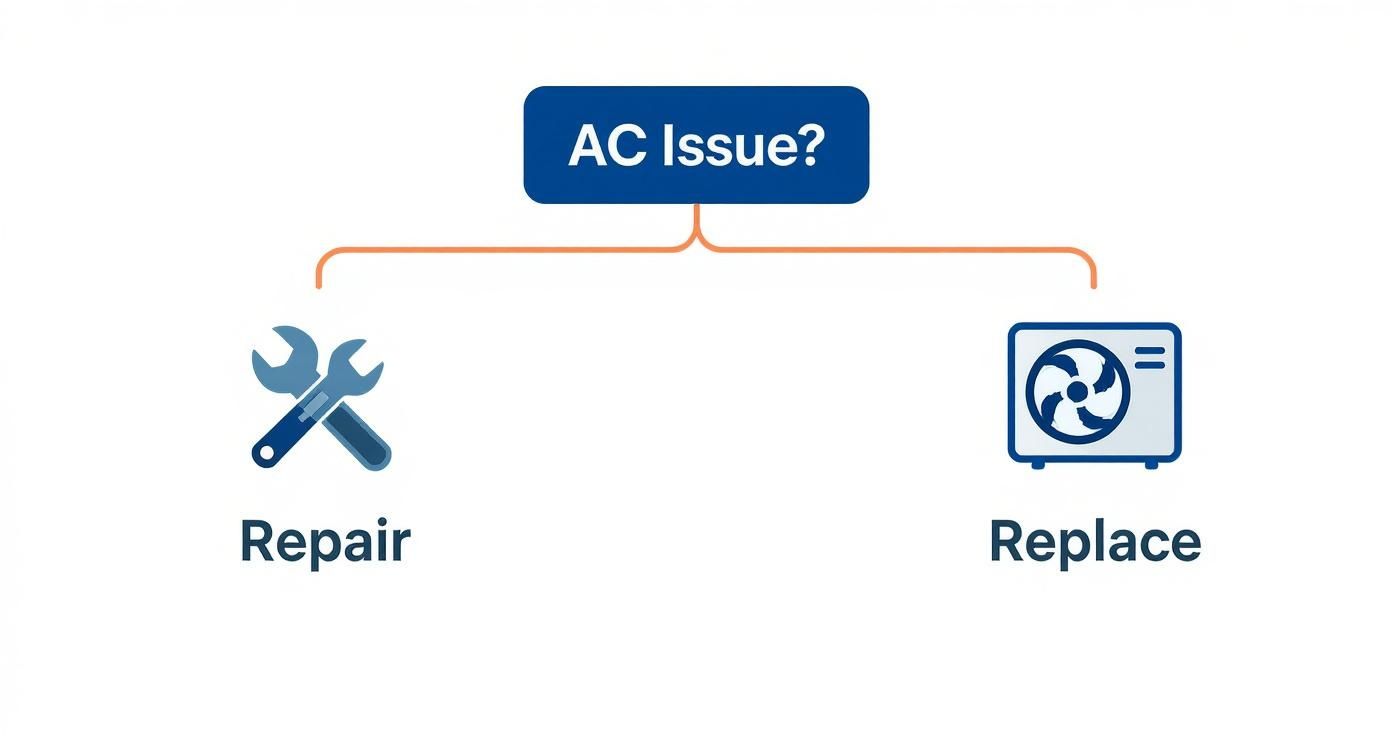
As you can see, small, inexpensive fixes on a younger system usually point toward a repair. On the other hand, a big, costly problem on an older unit almost always means replacement is the smarter path forward.
For an even faster gut-check, we've put together a simple table to help you weigh the options based on common warning signs.
The 50% Rule: A Pro's Rule of ThumbHere’s a simple guideline we often share with homeowners: if the cost of a repair is more than 50% of the cost of a new system, it’s almost always better to replace it. You'll get a more reliable and efficient unit.
Use this table to quickly assess common AC issues and determine if a repair or replacement is the most practical solution for your home.
Ultimately, looking at these factors together will give you a much clearer picture of whether you’re just patching a small leak or trying to keep a sinking ship afloat.
Your air conditioner rarely just gives up without a fight. Long before it quits on a sweltering summer afternoon, it sends out distress signals—subtle hints that it's struggling to keep up. Learning to recognize these symptoms is the key to avoiding a sudden, sweaty emergency.
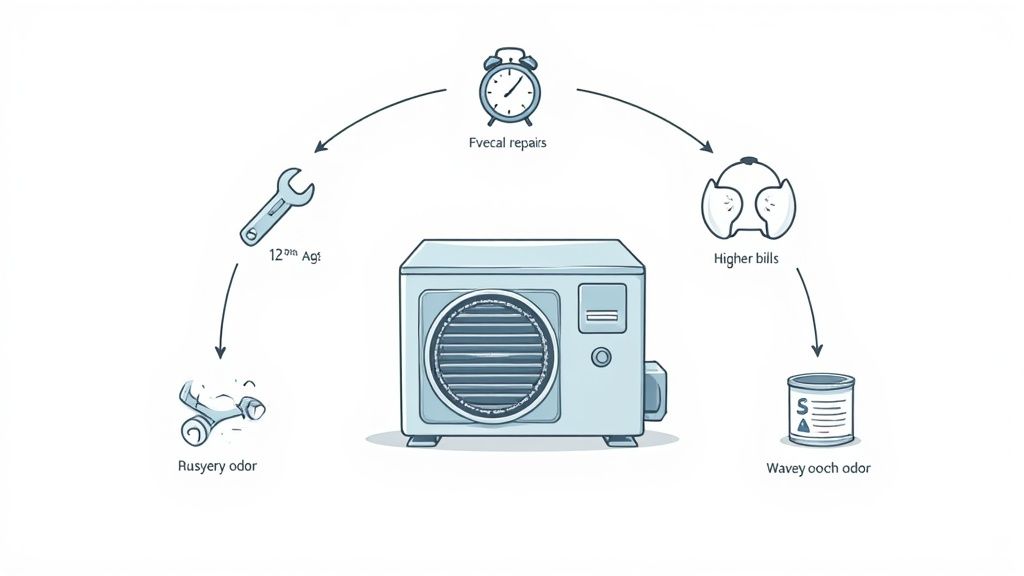
Think of these signs as your AC’s way of asking for help. Ignoring them doesn't make the problem disappear; it just leads to bigger repair bills, higher energy costs, and the inevitable system failure right when you need it most.
Are you on a first-name basis with your HVAC technician? While occasional tune-ups are a good thing, constant service calls are a major red flag. If you find yourself scheduling repairs every season, you're no longer just maintaining your unit—you're propping up a failing system.
This is where a simple financial guideline can bring much-needed clarity.
The 50% Rule ExplainedA handy rule of thumb in the HVAC world is the 50% Rule. If a single repair job is going to cost 50% or more of the price of a brand-new system, replacement is almost always the smarter financial move. Pouring that kind of money into an old, unreliable unit is a bad investment, especially when it could just break down again next season.
Instead of paying for another expensive part on an aging machine, that money is far better spent on a new, reliable, and energy-efficient system. This simple calculation helps you avoid throwing good money after bad.
Your air conditioner should operate with a gentle hum, not a symphony of mechanical distress. If new and alarming sounds have become part of your home's summer soundtrack, it’s time to pay attention.
These noises are often symptoms of serious internal problems:
Just as concerning are any strange smells. A musty or mouldy odour suggests that mould or mildew is growing inside your unit or ductwork, which means you're circulating spores throughout your home. A burning smell, on the other hand, can indicate a serious electrical fault that needs immediate attention. When in doubt, it's always best to get a diagnosis from experts in professional cooling services.
Perhaps the most obvious sign of a failing AC is that it simply doesn't cool your home like it used to. You might notice some rooms are warm while others are frigid, or that the unit seems to run constantly just to keep the temperature steady.
This drop in performance is directly tied to your hydro bill. An aging AC has to work much harder to produce the same amount of cool air because its components are worn and its coils might be clogged. It just can't operate as efficiently as it once did.
The result? Your electricity consumption skyrockets. If you've watched your summer hydro bills climb steadily year after year with no other explanation, your inefficient air conditioner is the likely culprit. Upgrading to a modern, energy-efficient model can often cut cooling costs by a significant 20-40%, delivering both comfort and immediate savings.
Let's be honest, an air conditioner in Canada has a tough life. It powers through sweltering, humid summer heatwaves only to be buried in snow and ice for months. This constant swing from extreme use to deep freeze puts a massive strain on every single part of the system.
This is exactly why your AC's age and performance are so tightly linked to your hydro bills.
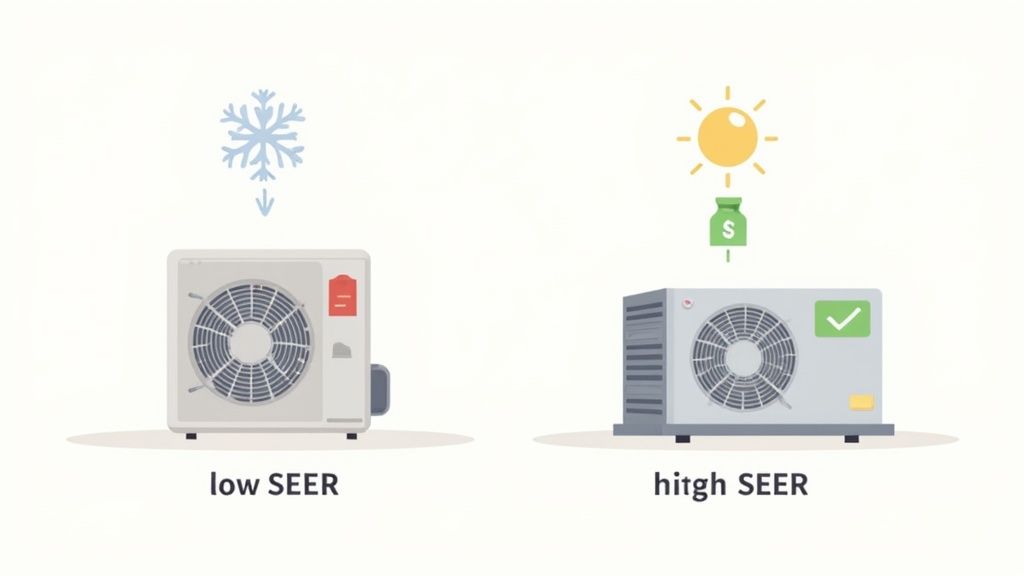
As an AC gets older, it doesn't just get closer to breaking down—it quietly becomes an energy hog. It works harder and runs longer to give you the same amount of cool air, and that extra effort shows up directly on your monthly bill. Understanding this slow, costly decline is the key to knowing when it's time for a replacement.
Every air conditioner has a Seasonal Energy Efficiency Ratio (SEER). You can think of it like the "litres per 100 km" rating on a car. A higher SEER number means the unit is more efficient—it uses less electricity to cool your home. It’s that simple.
Not too long ago, a SEER rating of 10 was perfectly acceptable. Today, the minimum standard for a new unit is significantly higher, and it's common to see models with ratings of 16, 18, or even more. That's a huge jump in technology.
Running an old AC with a low SEER rating is like driving a vintage V8 to the grocery store. Sure, it’ll get you there, but the fuel cost is painful. Every time that old unit kicks on, it's guzzling power and costing you money that a new system would save.
It’s easy to think you’re saving money by putting off a big purchase like a new air conditioner. But in reality, you’re likely spending those "savings" and more on inflated hydro bills every single summer.
Here’s a breakdown of what that inefficiency really means:
Upgrading your AC isn't just an expense; it's a strategic investment in your home's long-term energy costs. You’re essentially locking in lower hydro bills for the next decade or more, and that investment pays for itself through real, consistent savings.
This isn’t just a theory. The numbers back it up. For example, in a climate with demanding summers like California's, studies show that replacing an AC unit over 12 years old can cut air conditioning energy use by nearly 30%. You can read more about these energy consumption findings to see just how impactful an upgrade can be.
Ultimately, deciding to replace your old AC isn't just about dodging a heatwave breakdown. It's a smart financial move to slash your home's energy consumption, shrink your carbon footprint, and enjoy lower, more predictable bills for years.
Sooner or later, every homeowner is faced with a tough question: should you sink more money into repairing your old air conditioner, or is it finally time to replace it? It can feel like a high-stakes decision, but you can break it down with a bit of simple math. Thinking about it as a long-term investment is the key to turning a stressful problem into a clear financial choice.
At the end of the day, you have to ask yourself if you’re actually fixing the problem or just kicking the can down the road. It might feel like a win to get through another summer with a few-hundred-dollar repair, but those fixes add up. Before you know it, you've spent a small fortune on a machine that was already on its last legs.
To make this decision easier, we in the HVAC world often use a simple guideline called the 50% Rule. It’s a straightforward formula that helps you pinpoint the exact moment when replacing your AC becomes the smarter financial move.
Here's how it works: if a single repair is going to cost you 50% or more of what a brand-new, comparable air conditioner would cost, it’s time to seriously think about a replacement.
Let’s say a new AC system for your home would run you about $6,000. You get a quote to fix your current one, and the technician tells you the compressor has failed—a $3,200 repair. According to the 50% Rule, putting that much cash into an old unit is a bad bet. There’s simply no guarantee another expensive part won’t fail next season, leaving you stuck in a frustrating cycle of repairs.
When you opt for a new system, you're not just buying a piece of equipment. You're investing in 10-15 years of reliable performance and lower energy bills.
This rule of thumb helps you avoid that classic trap of throwing good money after bad. Instead, it steers your budget toward a solution that delivers real, lasting value and peace of mind.
Getting a handle on the cost of major repairs is essential when you're weighing your options. A small electrical fix might not break the bank, but a major component failure can get expensive—fast.
Cost is a huge factor, and understandably so. A new air conditioner is a significant investment, which is why many people put it off for as long as possible. The irony is that older units can be up to 30% less efficient, so you're often paying a penalty on your hydro bill every month just to keep it running.
To put it in perspective, let's look at what some common major repairs cost in Canada versus the long-term benefit of a full replacement.
Here’s a breakdown that can help you see where that financial tipping point really is.
As you can see, just one of these major repairs on an aging system can easily justify making the switch to a new unit.
This is especially true when you start looking at modern, high-efficiency alternatives. For instance, more and more homeowners are choosing a high-efficiency heat pump installation when it's time to replace their old AC. Heat pumps cool your home in the summer and heat it in the winter, and they often qualify for significant government rebates. This approach turns a necessary expense into a smart upgrade that saves you money all year long.
So you’ve decided it’s time for a new air conditioner. That's a big decision, but it doesn't have to be a stressful one. Think of this next phase as creating a game plan—a simple roadmap that will guide you from figuring out your budget to enjoying a perfectly cool home after the final installation.
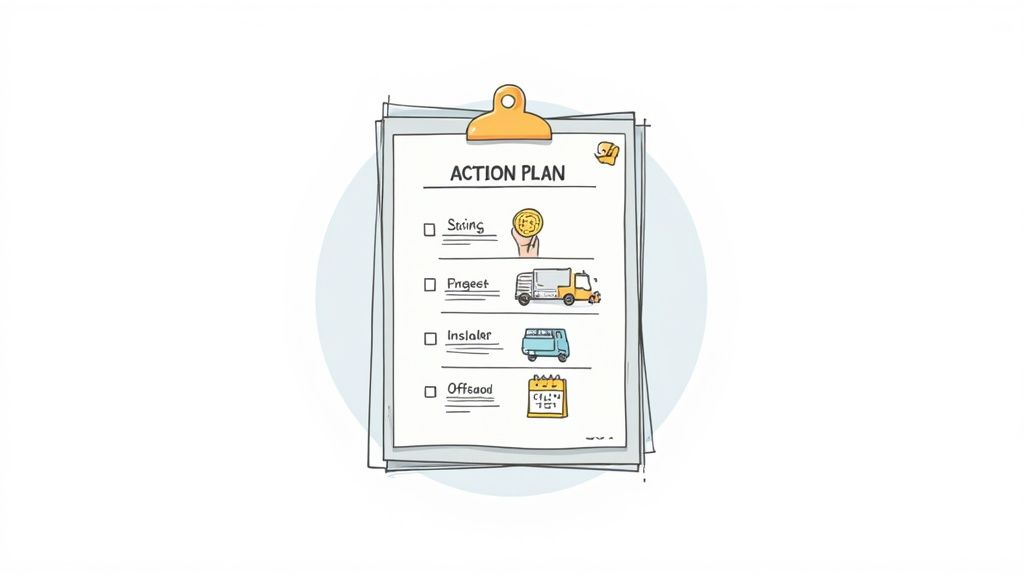
Getting organized now is like gathering your tools before starting a big project. When you nail down your budget, understand your options, and pick the right time to buy, you're setting yourself up for a smooth, successful upgrade without the last-minute panic.
First things first: let's talk money. A new air conditioner is a major home investment, so you need a realistic budget from the get-go. Figure out what you're comfortable spending, but don’t stop there. Most good HVAC installers offer financing plans that can make a top-of-the-line, high-efficiency unit much more affordable than you might think.
With a budget in mind, it's time to look at what's out there. These days, your options go way beyond the traditional AC unit you're replacing. Modern, all-in-one systems are becoming the new standard.
A heat pump is a fantastic, energy-efficient alternative that handles both your cooling and heating from a single piece of equipment. They're incredibly effective in the Canadian climate and often come with hefty government rebates, making them a smart financial move for long-term savings.
This isn't just a trend; it's a major shift. Take California, for example, where a big push for home electrification has made heat pumps the go-to replacement. Rebates there can knock $500 to $3,000 off the cost. If you want to dive deeper into how these programs work, you can explore detailed reports on heat pump programs to see the kind of incentives that are becoming available.
Here’s a piece of advice I can't stress enough: make sure your new unit is the right size for your home. And I don't mean its physical dimensions. I’m talking about its cooling capacity, measured in British Thermal Units (BTUs). Getting this right is absolutely crucial for your comfort and your wallet.
An oversized or undersized unit is just a recipe for trouble.
A professional HVAC technician doesn't guess. They perform what’s called a "Manual J load calculation" to find the perfect size. This detailed analysis accounts for everything—your home's square footage, insulation, window quality, and our local climate—to guarantee the system is a perfect match.
Finally, let's talk timing. Of course, if your AC dies in the middle of a July heatwave, you don’t have much choice. But if you can plan ahead, scheduling your replacement for the off-season—spring or autumn—is a game-changer.
During these milder months, HVAC contractors are not nearly as slammed. This usually means you’ll get more flexible scheduling, a better selection of equipment, and maybe even a better price. Being proactive instead of reactive almost always saves you money and a whole lot of stress.
Picking out the right air conditioner is only half the battle. Honestly, the quality of the installation is what truly dictates how well that new unit will perform and how long it will last.
A top-notch installation means your new system hums along efficiently from day one. On the flip side, a sloppy job can set you up for years of headaches and surprisingly high energy bills. The installer you choose is every bit as important as the equipment itself.
This is the final, crucial step. You've done the homework on when to replace your AC, and now it’s time to choose who will get the job done right.
Before you sign on the dotted line, a little due diligence can save you a world of trouble. Any reputable installer will be upfront and happy to show you their credentials.
Here are the non-negotiables to check for:
For homeowners and cottagers in Muskoka, finding a reliable local partner for your project is key. If you're ready to move forward, learn more about our professional air conditioning installation in Gravenhurst.
Even when you've made the decision to replace your air conditioner, a few practical questions almost always come up. It's totally normal. Getting these last few details ironed out will help you move forward feeling confident about your investment. Here are a few things we hear from homeowners all the time.
This is a great question. For a standard, swap-out replacement, you can expect the job to take a single day. Most of the time, our team can have the old system out and the new one running in about four to eight hours.
Of course, surprises can happen. If we find out your ductwork needs some major adjustments or the electrical setup isn't up to code, that can add time. But a good installer will spot these potential issues during the initial visit and build that extra time right into the quote, so you know exactly what to expect.
I get asked this one a lot, and it's a tempting thought, but the answer is almost always a firm no. Your air conditioner is what we call a "split system." This means the outdoor condenser and the indoor evaporator coil are engineered to work together as a matched set.
Think of it like a sports team—you can't just swap in a random player and expect top performance. Pairing a new, high-efficiency outdoor unit with an old, worn-out indoor coil will kill your energy savings and overwork the new compressor. To get the performance and lifespan you're paying for, you absolutely have to replace both units together.
For Canadian homeowners, switching from an old AC to a modern heat pump is probably the single smartest upgrade you can make right now. A heat pump isn't just an air conditioner; it’s a two-in-one system that gives you super-efficient cooling in the summer and, believe it or not, powerful heating in the winter.
The real-world benefits are huge:
Ready to take the next step with confidence? The team at Bridlewood Mechanical provides expert advice and flawless installations. Contact us today for a transparent, no-pressure quote.









Free, no-obligation quote
Tell us what's going on with your heating, cooling or water heater and we'll follow up to book a visit.
Prefer to talk? Call us directly(705) 706-7622Thanks, we've got your request.
We'll be in touch shortly. Need us sooner? Call (705) 706-7622.
Sorry, that didn't send. Please try again or call (705) 706-7622.
Service Tankless Water Heater: The Pro's Maintenance Guide
Repair Heating System: When DIY Isn't Enough
Discover our dedication to delivering tailored, high-quality HVAC solutions.
Copyright © Bridlewood Mechanical 2025 | Designed By Vodata Digital


