


Service Tankless Water Heater: The Pro's Maintenance Guide
Service Tankless Water Heater: The Pro's Maintenance Guide
Read more


Free, no-obligation quote
Tell us what's going on with your heating, cooling or water heater and we'll follow up to book a visit.
Prefer to talk? Call us directly(705) 706-7622Thanks, we've got your request.
We'll be in touch shortly. Need us sooner? Call (705) 706-7622.
Sorry, that didn't send. Please try again or call (705) 706-7622.
There's a particular kind of quiet that sinks in when you realize the house is getting colder and the furnace hasn't kicked on. That sudden silence, where the familiar hum of your heating system should be, is enough to make any homeowner's stomach drop.
But before you jump to conclusions about a catastrophic failure, take a deep breath. While some heating emergencies have simple fixes, knowing when to call a professional is key to preventing a small problem from becoming a major, expensive one. A few quick checks can sometimes get the heat back on, but they also help you give a clear report to a technician if a service call is needed.
Think of this as first aid for your HVAC system. These aren't complicated technical tasks; they’re the first things any pro would check, and you can absolutely do them yourself before calling for professional help.
Your thermostat is the brain of the operation, so it's always the first place to look. It’s amazing how often the problem is just a setting that’s been accidentally changed—kids love pushing buttons, and power flickers can reset digital models.
Make sure it's actually set to “Heat.” Then, crank the temperature setting up at least 5 degrees higher than the current room temperature. This is the surest way to send a clear signal to your furnace that it's time to get to work.
If the thermostat settings are correct, it's time to follow the power. Your furnace needs electricity to run, and a couple of common trip-ups can cut the supply.
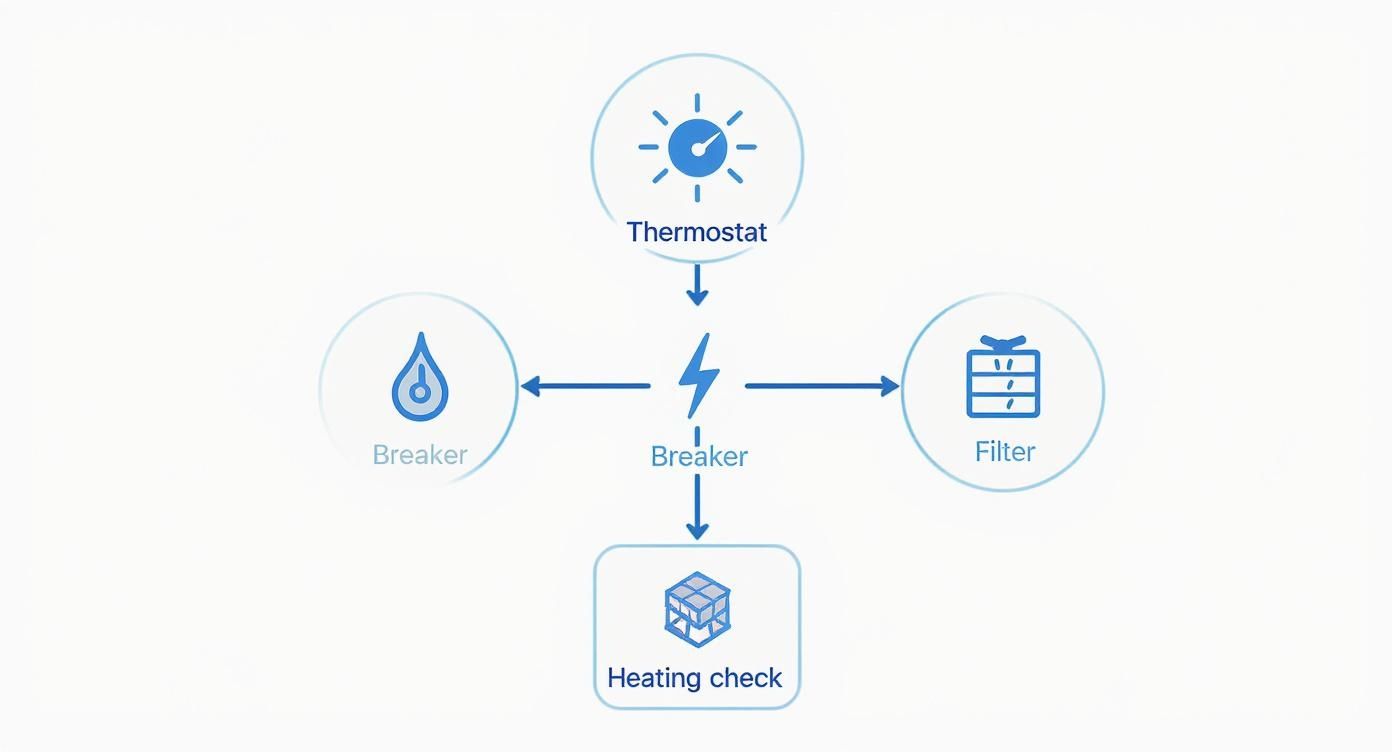
This quick diagnostic path—from thermostat settings to power sources—should always be your first move. If these steps don't solve the issue, it’s a strong sign that the problem lies deeper within the system and requires a professional eye.
Okay, so the power is on and the thermostat is calling for heat, but still nothing? The next stop on our tour is the single most common cause of furnace problems: the air filter.
When a filter gets clogged with dust and debris, it literally suffocates your furnace. The system can't pull in enough air to function properly, causing it to overheat and shut down automatically. This is a built-in safety feature to prevent a fire or serious damage.
A dirty filter is the number one cause of heating system breakdowns. It forces the entire system to work harder, leading to higher energy bills, excessive wear on components, and eventually, a total failure.
Finding and checking it is simple. Locate the filter compartment on your furnace (it's usually a wide slot), slide the old filter out, and hold it up to a light. If you can't see the light through it, it's toast.
Popping in a fresh, clean filter might be all it takes to get your heat running again. It’s also the most important piece of routine maintenance you can do to prevent needing to repair your heating system in the future. If this doesn't work, it's time to let an expert take over.
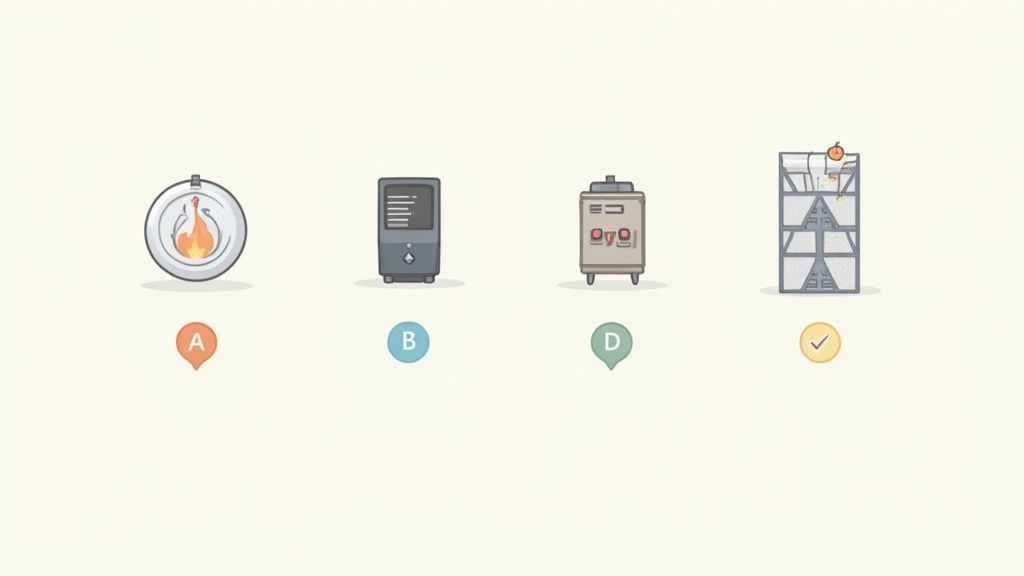
Before you pick up the phone, running through a few simple diagnostics can save you a lot of hassle. I've created this quick checklist to summarize the key things to look for.
Working through these four points systematically will resolve a huge percentage of common heating issues. If your heat is still out after checking everything on this list, then it's time to call in a professional.
Your heating system has its own language, and it often gives you warning signs long before it decides to quit on a cold January night. Learning to interpret the groans, bangs, and strange whiffs is the key to catching a small problem before it morphs into a major, expensive repair.
One of the biggest mistakes we see homeowners make is ignoring a new sound. That noise you’ve started to tune out could be the first sign of serious mechanical stress on a critical part. Attempting to diagnose these sounds on your own can be risky; calling a professional ensures the problem is identified correctly and safely.
Different sounds point to very different problems. A high-pitched squeal is telling a completely different story than a loud bang when the system starts up. Here’s a quick guide to translating what you’re hearing.
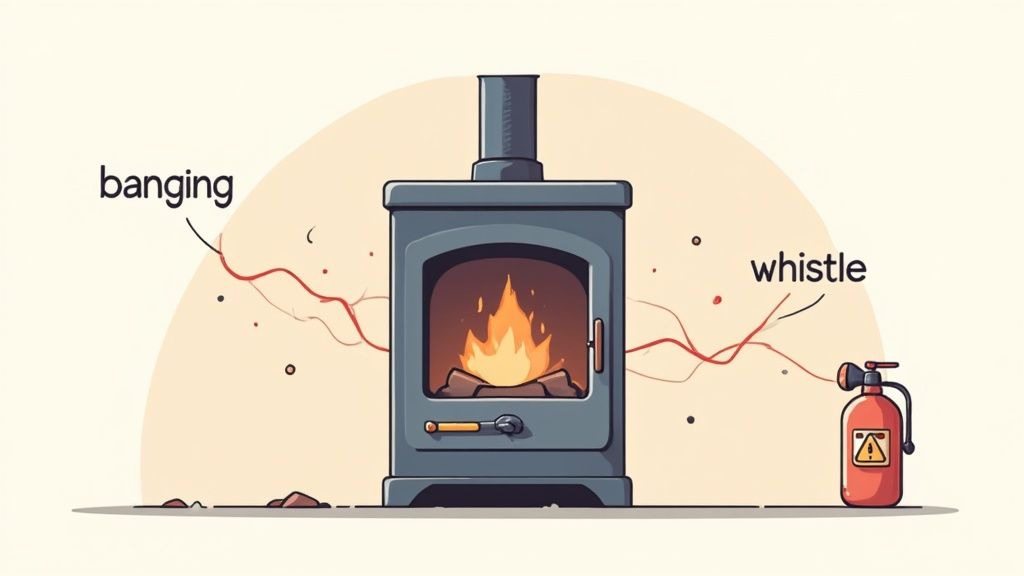
Banging or BoomingA sudden, loud bang when the furnace kicks on can be startling. This is often the sound of delayed ignition—a small buildup of gas in the combustion chamber that ignites all at once. This requires immediate professional attention as it can crack your heat exchanger. It could also just be your metal ductwork expanding, which is harmless. A technician can tell the difference.
Whistling or ScreechingThat high-pitched whistling or screeching almost always points to an issue with airflow. The most common culprit is a severely clogged air filter, but it can also signal a failing blower motor or issues within your ductwork. You can learn more about how these issues impact your home's overall airflow in our guide to ductwork installation services.
Grinding or ScrapingThis is one sound you should never ignore. A metallic grinding or scraping noise is a serious red flag. It typically means the blower motor's bearings are shot. If you hear this, shut the system down immediately to prevent catastrophic damage and call for service. Letting it run could destroy the entire motor assembly, turning a manageable repair into a complete replacement.
Just like strange noises, certain smells are urgent signals from your heating system. You need to know the difference between a harmless, temporary odour and one that signals a real danger.
A persistent burning or electrical smell is a sign of an overheating motor or bad wiring. Don't hesitate—turn off your heating system at the breaker panel right away and call us immediately to prevent a potential fire.
If you've had to call for a heating repair lately, you probably experienced a bit of sticker shock. You might have also found yourself waiting longer than you'd like for a technician to show up. It’s not just you, and it’s not just a local thing—it's a major shift happening across the entire HVAC industry.
Knowing what's behind these changes helps explain why investing in a professional service partner is more important than ever. It's not just about keeping your system running; it's a smart financial move in a world where quick, cheap fixes are becoming a thing of the past.
The biggest reason for higher costs and longer waits? A serious, industry-wide shortage of skilled HVAC technicians. It’s a simple but frustrating numbers game. Experienced pros are retiring faster than new apprentices are joining the trade, which creates a huge gap between the number of qualified technicians and the number of homes that need service.
This is why having a trusted relationship with a reliable HVAC company is so valuable. As a valued client, you get priority service, ensuring you aren’t left waiting in the cold.
It's a problem that's only getting worse. Experts project a nationwide shortage of up to 225,000 technicians by 2025, with about 42,500 job openings going unfilled each year. This can stretch what used to be a same-day service call into a week-long wait during peak season for those without a service plan.
That imbalance hits your wallet directly. When the demand for skilled labour is much higher than the supply, the cost of that labour goes up. It's basic economics, and it shows up on your final invoice.
On top of the labour crunch, we're still dealing with stubborn disruptions in the global supply chain. The complex web that gets parts from the factory to your home—from tiny electronic boards to massive heat exchangers—is still feeling the aftershocks of recent global events.
For homeowners, this causes a couple of major headaches:
These two forces—fewer skilled hands and harder-to-get parts—have created a perfect storm. It’s a new reality that highlights just how valuable preventative maintenance really is. Catching a small issue early can save you from a major, expensive repair caught in the middle of today’s market pressures.
Every homeowner with an older furnace eventually faces the same tough question: do I sink more money into another big repair, or is it finally time to replace the whole thing? It’s a tricky decision. You’re not just weighing the immediate cost, but trying to avoid a frustrating cycle of expensive, temporary fixes while planning for your home's long-term comfort and efficiency.
Our team can provide a professional, no-pressure assessment to help you make an informed choice. A typical furnace might last 15-20 years, but how often you’ve had to call for service lately—and how much those visits cost—is often a far more telling sign that your system is on its last legs.
Here’s a practical guideline we use to advise homeowners: the 50 percent rule. If a repair quote comes in at half or more of what a brand-new system would cost, replacement is almost always the smarter financial move. Pouring that much cash into an aging unit that’s likely to break down again just doesn't make sense.
The other big tell is your energy bill. An older furnace has to work much harder and run longer to produce the same amount of heat it used to. If you’ve been watching your utility costs creep up every winter, your furnace’s inefficiency is probably the culprit.
Investing in a new, high-efficiency system isn't just about getting a new appliance; it's a long-term strategy to lower your monthly expenses. We can show you exactly how much you stand to save, helping the new system pay for itself over time.
To help you visualize the decision, here's a quick comparison:
Ultimately, this table gives you a framework, but your situation is unique. A system that’s been well-maintained might last longer, while one that’s been neglected might need replacing sooner. Let our experts give you a clear, honest evaluation.
It's not just about age and performance anymore, either. Evolving environmental regulations are making it more expensive and difficult to keep older systems running. A great example is the major regulatory changes coming in 2025, mandated by environmental agencies to phase down older refrigerants like R-410A, which are common in heat pumps and AC units.
As these older components are phased out, they become scarce and incredibly expensive. This means the cost to service and repair older models is going to spike, pushing many homeowners toward replacement sooner than they might have planned. You can find more details on how these 2025 HVAC changes will affect prices.
This shift doesn't just hit your wallet—the availability of parts for outdated systems will keep shrinking. Getting ahead of this by upgrading your equipment, whether to a new furnace or by exploring the benefits of a heat pump installation, future-proofs your home. Making a proactive choice now can save you from a major headache (and a cold house) down the road.
When it comes to your heating system, the cheapest repair is the one you never have to make. It sounds obvious, but shifting from a reactive "fix it when it breaks" mindset to a proactive one is the smartest financial move a homeowner can make.
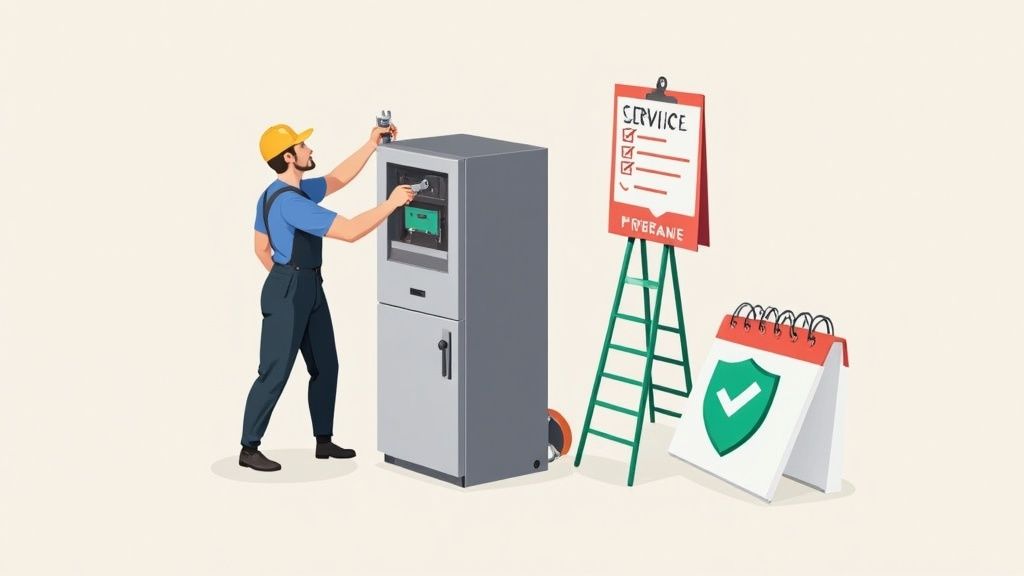
An annual tune-up isn't just a quick once-over. It’s a deep dive into the health of your system, designed specifically to catch small issues before they spiral into system-wide failures. A trained technician doesn't just look—they measure, test, and fine-tune every critical component.
During a maintenance visit, a professional is hunting for the exact signs of wear and tear that lead to those dreaded no-heat emergency calls. Think of it as preventative medicine for your furnace or heat pump.
They’ll focus on the little things that cause big headaches:
Replacing a worn-out part during a scheduled visit is a relatively small, predictable expense. But if that same part gives out during a deep freeze, you’re looking at an emergency call-out fee, premium rates for labour, and a cold house while you wait for a fix.
The real value of maintenance isn't just about saving money—it's about peace of mind. It’s knowing your heating system has been professionally vetted and is ready to handle whatever winter throws at it.
Trying to save a bit of cash by skipping your annual service is a gamble that almost never pays off. The cost gap between prevention and reaction is massive. A planned maintenance visit is a small, budgeted expense. An emergency breakdown is a sudden, and often significant, financial shock.
Just look at what's happening elsewhere. Homeowners in some regions are facing HVAC repair costs that are 20–40% higher than the national average. And the data is clear: skipping a basic seasonal tune-up is a leading cause of emergency repairs that can run into the thousands during the coldest months. You can see how this plays out for homeowners by reading these insights on rising HVAC costs.
The lesson here is simple. Investing a small amount in an annual service plan is a direct investment in your home’s reliability and your own financial stability. It's the easiest way to sidestep the stress, discomfort, and high cost of a mid-winter heating failure.
When a heating problem goes beyond what you can safely fix yourself, the technician you invite into your home makes all the difference. You aren’t just looking for a quick fix; you're looking for a long-term partner who genuinely cares about your home’s comfort, safety, and efficiency.
That’s where real expertise and trust come into play. It’s about finding a team that stands behind their work, ensuring that any repair to your heating system is done right the first time so you can have peace of mind all winter long.
This level of coverage isn't just about protecting your wallet; it’s our promise to build a lasting relationship and be there for you when you need us.
Finding a service provider isn't just about solving today's problem. It’s about finding a reliable expert you can count on for years, someone who will ensure your system keeps running safely and efficiently season after season.
Modern heating technology has come a long way, offering incredible ways to slash your energy bills while making your home more comfortable. But let’s be honest—navigating all the options can be overwhelming. A true expert does more than just fix what's broken; they help you see the bigger picture.
We specialize in high-efficiency systems, especially heat pumps that are perfectly suited for our Canadian climate. Our job is to give you clear, honest advice on which upgrades will actually deliver a solid return for your home and budget.
Better yet, we actively help homeowners tap into the government programs designed to make these upgrades more affordable. We keep on top of all the latest local and federal rebates, walking you through the application process to make sure you get every dollar you're entitled to. We turn a confusing task into a simple, rewarding one.
At the end of the day, you just want a warm, safe, and efficient home. Our goal is to be the trusted partner who helps you get there. We believe in transparent pricing, clear communication, and treating your home and your time with the respect they deserve.
If you’re facing a heating challenge or just want to explore better, more efficient options, let's talk. We can build a plan to keep your family comfortable for years to come. For a professional consultation to understand your options, please contact us today.








Free, no-obligation quote
Tell us what's going on with your heating, cooling or water heater and we'll follow up to book a visit.
Prefer to talk? Call us directly(705) 706-7622Thanks, we've got your request.
We'll be in touch shortly. Need us sooner? Call (705) 706-7622.
Sorry, that didn't send. Please try again or call (705) 706-7622.
Service Tankless Water Heater: The Pro's Maintenance Guide
How Long Do Heat Pumps Last? A Homeowner's Guide to Longevity
Discover our dedication to delivering tailored, high-quality HVAC solutions.
Copyright © Bridlewood Mechanical 2025 | Designed By Vodata Digital


