


Service Tankless Water Heater: The Pro's Maintenance Guide
Service Tankless Water Heater: The Pro's Maintenance Guide
Read more




Free, no-obligation quote
Tell us what's going on with your heating, cooling or water heater and we'll follow up to book a visit.
Prefer to talk? Call us directly(705) 706-7622Thanks, we've got your request.
We'll be in touch shortly. Need us sooner? Call (705) 706-7622.
Sorry, that didn't send. Please try again or call (705) 706-7622.
Trying to figure out what size heat pump you need can feel a bit overwhelming, but there's a simple rule of thumb that gives you a great starting point.
Most HVAC pros will tell you to estimate about one ton of capacity for every 500-600 square feet of living space. This is just a quick, back-of-the-napkin calculation, but it gives you a solid foundation before we dig into the details that really matter for your specific home.
Before you even think about calling a professional, it helps to have a rough idea of what you might need. The first step is getting familiar with the lingo. Heat pump capacity is measured in two ways: British Thermal Units (BTUs) per hour and "tons."
It's actually pretty simple: one ton of capacity is equal to 12,000 BTUs per hour.
So, when you see a 3-ton unit, it means that system has the power to move 36,000 BTUs of heat out of your home every hour during the summer. These numbers are a direct measure of the system's muscle for heating and cooling your space. While these quick estimates are helpful, they don't capture the full picture of your home's unique heating and cooling needs. You can learn more about how different factors affect these sizing guidelines to see why a professional assessment is so important.
This quick overview shows how your home's size gives you a starting point for figuring out the BTUs you'll likely need.
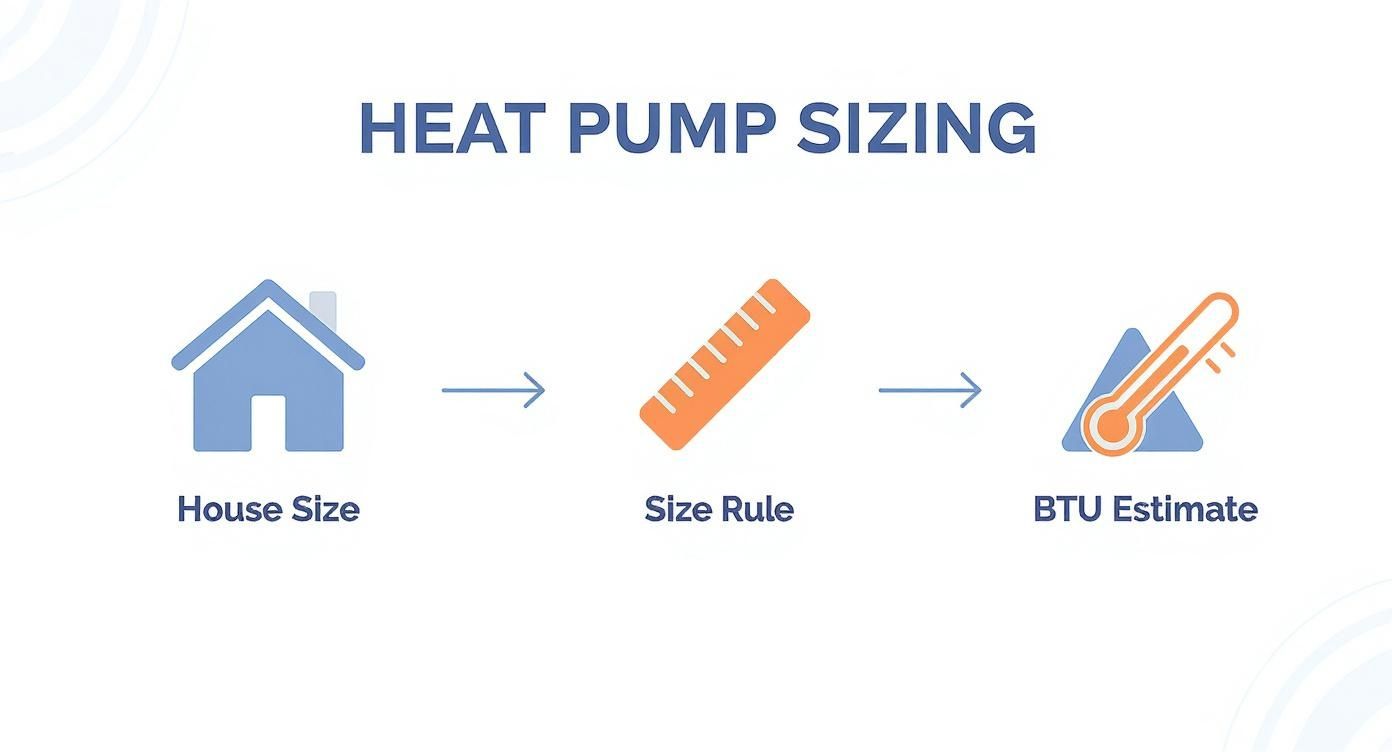
Think of this as a simple roadmap for your sizing journey—it helps you get your bearings before diving deeper.
While every home has its quirks, using a square-footage-based chart is a much better way to get a ballpark figure than just guessing. It’s a definite step up, but it's still a preliminary tool.
Key Takeaway: An estimate based on square footage is your first step, not your final answer. It gives you a baseline to start a conversation with an HVAC professional, who will perform a detailed calculation to find the exact size your home requires.
It's a bit like buying a suit. Knowing your general size gets you to the right rack, but you wouldn't buy it without trying it on for a perfect fit. The same logic applies here—the estimate gets you in the right ballpark, but the final choice needs a professional fitting.
To make this first step even easier, we've put together a handy reference table. This gives you a quick way to connect your home's square footage to a recommended heat pump size in both tons and BTUs.
This table provides a quick reference for homeowners to estimate the required heat pump size (in tons and BTUs) based on the total square footage of their home. It serves as a general guideline before a professional assessment.
Just keep in mind, this chart is based on a "standard" home—one with 8-foot ceilings, decent insulation, and an average number of windows. In the next sections, we’ll get into why these factors can make a huge difference.
For now, you've got a solid starting point. This initial estimate arms you with the knowledge to have a much more informed conversation about what your home really needs to stay comfortable all year round.
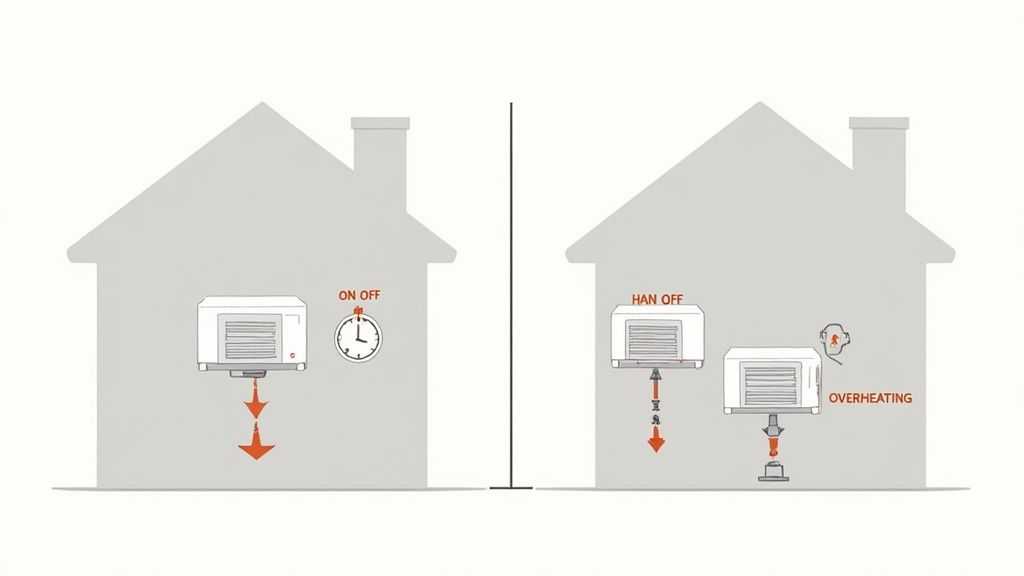
It’s a common trap many homeowners fall into: assuming a bigger, more powerful heat pump is always the better choice. It seems logical, right? More power should equal more comfort. But in the HVAC world, this is one of the most expensive myths out there. Nailing the right size isn’t just a technical detail—it’s the cornerstone of your home’s comfort, efficiency, and the longevity of your system.
Get the size wrong, either too big or too small, and your new heat pump will fight a constant, losing battle. And you'll be the one paying for it with frustrating temperature swings and sky-high energy bills.
When a heat pump is too large for the space it’s trying to heat and cool, it behaves like a sprinter trying to run a marathon. It blasts the room with a powerful gust of conditioned air, hits the thermostat's set point in minutes, and then abruptly shuts down. This constant on-and-off behaviour is called short-cycling, and it's a killer for your equipment.
This relentless starting and stopping puts a huge amount of strain on the compressor, which happens to be the most critical and expensive part of your heat pump. Think of it like starting your car engine only to shut it off every two minutes on your way to work—it's just not designed for that kind of abuse and will wear out fast.
Beyond the mechanical damage, short-cycling creates a genuinely uncomfortable home. You'll get those jarring hot and cold spots as the system overshoots the temperature, shuts off, and lets the room drift back to being uncomfortable. It never gets the chance to run long enough to properly mix and circulate the air.
One of the most important jobs of a heat pump in the summer is to dehumidify your home. But an oversized unit that short-cycles never runs long enough to pull that sticky moisture out of the air. The result? A home that feels damp and clammy, even when the thermostat says it's cool.
Going too small presents an entirely different, but equally frustrating, set of problems. An undersized heat pump is like trying to tow a heavy trailer with a small car engine. It’s going to run constantly, straining with all its might, but it will never quite get you where you need to go.
On the coldest days of a Muskoka winter or during a sweltering summer heatwave, that little unit will run non-stop. And despite its best efforts, it just won't be able to keep your home comfortable. This continuous operation not only causes excessive wear on every component but also sends your energy bills through the roof.
You'll really feel the struggle when you need it most:
All that strain means the system is far more likely to break down, usually on the most extreme day of the year, leaving you with an emergency repair bill. An undersized heat pump essentially works itself into an early grave, failing years before it should. This is why getting the answer to "what size heat pump do I need" right from the start is so critical.
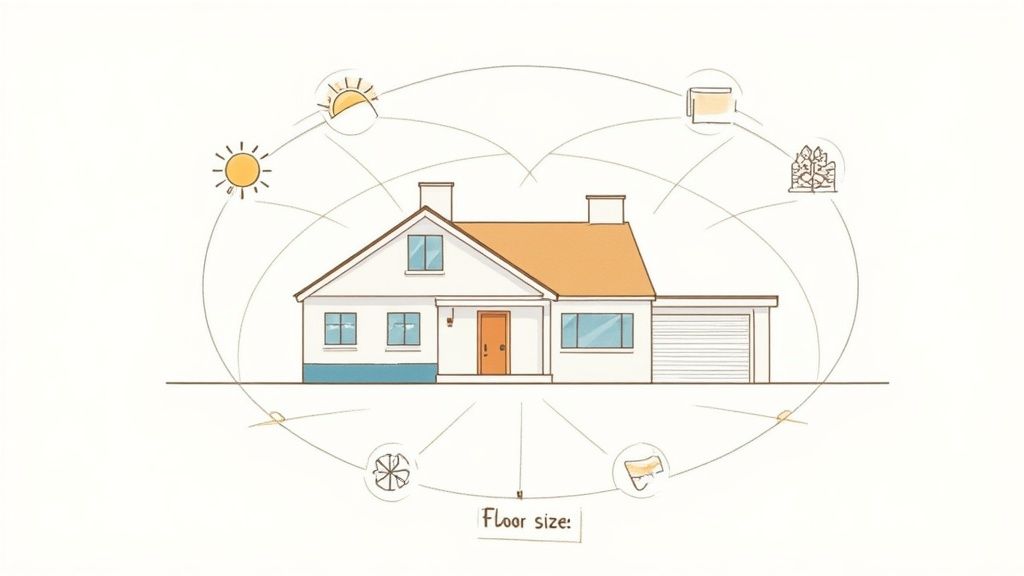
If you've plugged your square footage into a chart, you've got a ballpark number. That’s a start. But to truly nail down the right size heat pump for your home, we need to go much deeper.
Think of your house as having its own unique personality. Its age, how it was built, even which way it faces the sun—all these traits dictate its real heating and cooling demands. A quick estimate based on size alone is like guessing someone's jacket size without seeing them. You might get close, but a perfect fit is unlikely. The truth is, two 2,000-square-foot homes can have wildly different energy needs, and understanding why is the key to choosing a system that runs efficiently and keeps you comfortable.
The single biggest factor that influences the size of your heat pump is, without a doubt, your local climate. A cottage in the heart of Muskoka has to battle long, deep-freeze winters where reliable heating is non-negotiable. That same system would be overkill for a home in a milder region, which might need more cooling power to handle humid summers.
This is where the pros get specific. We use climate data for your exact location, looking at what are called "design temperatures." This tells us the coldest and warmest temperatures your system will likely ever face. A heat pump has to be muscular enough to keep you warm on the most frigid night of the year, but not so oversized that it’s inefficient the other 99% of the time.
"Building envelope" is just a trade term for the shell of your home—the roof, walls, windows, doors, and foundation that separate your living space from the outdoors. The better that shell is at keeping heat in during the winter and out during the summer, the smaller and more efficient your heat pump can be.
Here are the key components we look at:
A well-sealed, modern home might only need a 2-ton unit, while a drafty, older home of the exact same size could require a 3.5-ton system just to keep up. This difference highlights why a detailed assessment is not just a suggestion—it's essential for proper sizing.
This reality is backed up by housing data. The median size of a single-family home in many areas is around 1,665 square feet. Many of these were built from the 1990s onward and feature much better insulation and tighter construction, which naturally leads to lower energy demands.
Believe it or not, how you live in your home and its internal layout also play a big role in sizing a heat pump. These are the details that online calculators always miss.
For example, a house with soaring 12-foot ceilings has a much larger volume of air to heat and cool than the same square footage with standard 8-foot ceilings. An open-concept layout lets air move freely, but a home with lots of small, closed-off rooms might need a more specialized solution, like the zoned systems used in ductless heating and cooling.
Even your family's habits can shift the needle. Do you have huge south-facing windows that bake the living room on summer afternoons? Do you do a lot of cooking or run heat-generating electronics? These "internal gains" actually reduce your heating needs slightly in the winter but add to the cooling load in the summer. A proper, professional load calculation accounts for every last one of these variables, ensuring your system is sized perfectly for your real life.
While those quick rules of thumb and square footage charts are great for a ballpark estimate, they’re still just educated guesses. To really nail the answer to "what size heat pump do I need?" you have to go beyond approximations and use the method every seasoned professional relies on: the Manual J load calculation.
This isn't just some fancy formula. Think of it as a complete energy audit of your home, a deep dive into its unique thermal personality. It’s a bit like a forensic investigation, uncovering exactly how your house gains and loses heat through the seasons. It's truly the only way to get a precise heating and cooling load (measured in BTUs) and ensure your system is perfectly matched to your space.
A proper Manual J calculation is worlds away from just measuring your home's square footage. A certified technician systematically inspects every single element that affects how your home holds onto or sheds heat. It's a meticulous process, but it's what guarantees the heat pump we recommend is a perfect fit, not just a close-enough guess.
The assessment digs into a whole host of critical factors:
A Manual J calculation isn't just a suggestion; it's the definitive roadmap for your HVAC system. It replaces guesswork with hard data, ensuring your investment delivers the comfort and energy savings you were promised. Without it, you're really just rolling the dice.
This is exactly why a professional assessment is a non-negotiable step before making a major investment like a new heat pump.
The incredible precision of a Manual J calculation has a direct impact on your comfort and your bank account. For instance, a home that recently got upgraded triple-pane windows and a freshly air-sealed attic might need a heat pump that’s a full ton smaller than what an online calculator would suggest. That’s a huge upfront saving on the equipment, not to mention the lower energy bills you'll enjoy for years.
Beyond the initial cost, the data from the calculation helps us design a better system overall. It can pinpoint rooms that need better airflow or reveal simple ways you can boost your home’s efficiency before the new unit even goes in.
When you pair this precise sizing with modern controls, you get an incredibly efficient home. This is especially true when you add devices like smart thermostats into the mix; a properly sized unit allows them to work their magic much more effectively. You can see more about how our team handles smart thermostat installations to get the most out of your system.
On a bigger scale, as more and more homeowners switch to electric heat, this precise sizing becomes critical for everyone. Managing this new demand on the electrical grid is essential for keeping things reliable and avoiding costly infrastructure upgrades. You can read more about the importance of efficient heat pump adoption to see the broader impact.
At the end of the day, a professional load calculation is an investment in peace of mind. It protects you from the headaches and high costs of an incorrectly sized system, making sure your new heat pump performs perfectly from day one.
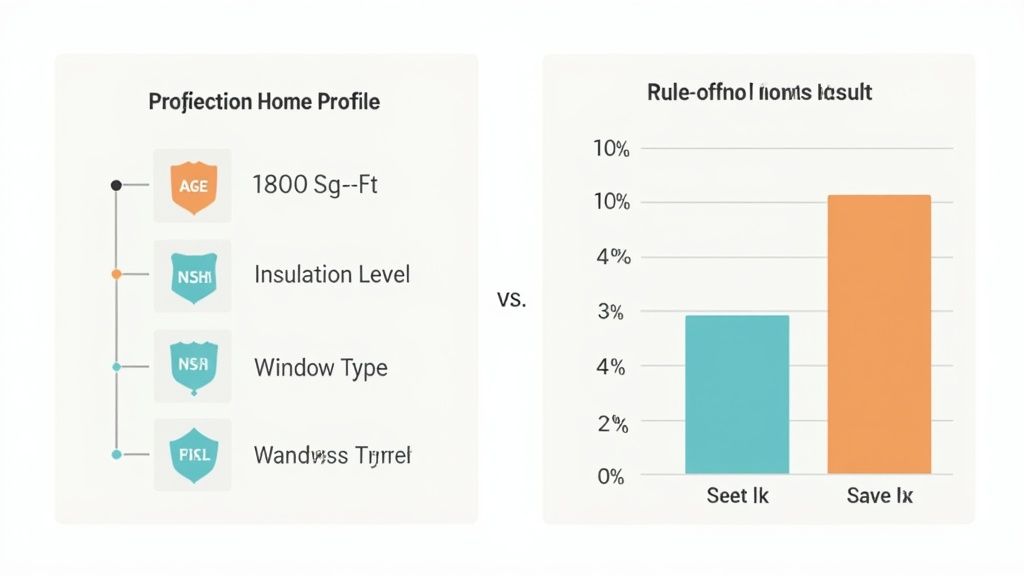
Theory and charts are one thing, but let's put these concepts into practice. The best way to understand why a detailed assessment is so critical is to see how different factors can completely change the sizing recommendation for the same house. It’s a common misconception, but two homes with the exact same square footage can easily require completely different heat pump sizes.
To make this tangible, let's invent a home: The Miller Cottage, a classic 1,800 square foot bungalow up in the Muskoka region. We’ll look at two versions of this same cottage to see just how dramatically the little details can change the answer to "what size heat pump do I need?"
First up, let's imagine the Miller Cottage as it was built back in 1985. It's a charming place, but its construction reflects the standards of the time, and that directly impacts its energy needs.
If we just use our quick rule-of-thumb chart, the 1,800 sq. ft. size points to a 3.0-ton (36,000 BTU) unit. That’s our starting point.
But any professional running a proper heat loss calculation (like a Manual J) would immediately see red flags. The poor insulation and drafty windows mean the cottage is constantly leaking heat in the winter and soaking it up in the summer. To keep up, the system needs more power.
After a full assessment, the final recommendation would almost certainly be a larger 3.5-ton (42,000 BTU) heat pump.
Key Takeaway: If the Millers had simply bought the 3.0-ton unit based on square footage alone, they'd have an undersized system. It would run non-stop on the coldest and hottest days, struggle to keep them comfortable, and force their expensive backup heat to kick in far too often.
Now, let's fast-forward. The Millers have recently invested in some major energy-efficiency upgrades for their 1,800 sq. ft. cottage.
The square footage hasn't changed a bit—it's still 1,800 square feet. The rule of thumb would still nudge us toward that same 3.0-ton unit.
But the home's ability to hold onto conditioned air is night and day. With a tight building envelope, great windows, and deep insulation, the cottage's heating and cooling "load" is now drastically lower. A proper Manual J calculation would show that a 2.5-ton (30,000 BTU) heat pump is all they need.
This example makes it crystal clear: square footage is just one piece of a much larger puzzle. The unique characteristics of your home—its age, windows, and insulation—have a massive effect on the final calculation.
This table shows how those features change the needs of the same 1,800 sq. ft. house.
As you can see, the upgrades resulted in a full 1.0-ton difference in the required equipment size.
By choosing the correctly sized 2.5-ton unit for their modernized cottage, the Millers not only save money on the initial purchase but ensure their system runs far more efficiently for years. They'll avoid the short-cycling and wasted energy that an oversized 3.0-ton or 3.5-ton unit would have caused. This proves that a personalized assessment isn’t just a formality—it’s the only way to make a smart investment.
Figuring out the perfect heat pump size is a huge first step, but it’s really only half the battle. Even the most advanced, perfectly sized system will fall short if the installation itself is botched. It's the quality of the installation that makes the difference between an efficient system that lasts for years and one that gives you nothing but headaches.
This is why choosing the right certified HVAC contractor is just as critical as picking the right brand or model. You need to partner with a team that has real-world experience with local building codes and carries all the proper licensing and insurance. It's the only way to protect your investment and ensure your new system runs safely and correctly right from the start.
At Bridlewood Mechanical, we know that precision is everything. Our job isn’t just to sell you a box; it’s to make sure that box performs flawlessly for its entire lifespan. Our licensed technicians never rely on guesswork or overly simple square-footage rules of thumb.
Instead, we insist on performing meticulous Manual J calculations for every single project. This is the gold standard in the HVAC industry, allowing us to pinpoint your home’s exact heating and cooling needs. It guarantees you get a system that’s just right—not undersized and struggling, or oversized and wasting energy.
We also pride ourselves on being experts in navigating the often-confusing world of local and federal rebates. Our team keeps up with every available program to help you maximize your savings on a top-tier system. We handle the paperwork so you can focus on the comfort.
A top-notch heat pump installation is about more than just connecting pipes and wires. It’s about understanding the science behind how your home works, paying close attention to every detail, and being committed to delivering the long-term efficiency and comfort you were promised.
Ultimately, our goal is to earn your trust through clear communication and expert work. We want to show you what a truly seamless, professional installation looks like. To see exactly how we approach our projects and stand by our commitment to quality, take a look at our professional heat pump installation services.
Even after you've done your homework on heat pump sizing, a few questions are bound to pop up. That’s perfectly normal. Getting clear, straightforward answers is key to feeling confident in your choice. Let's walk through some of the most common questions we hear from homeowners every day.
Online calculators can be a handy tool for getting a ballpark figure, but that's where their usefulness ends. Think of them as a starting point, not the finish line. They can give you a rough idea, but they can't possibly account for the unique character of your home.
What are these calculators missing? Quite a lot, actually:
There's simply no substitute for a professional Manual J calculation. It's the only way to guarantee you're getting the precise size needed for your home to be both efficient and comfortable for years to come.
This is a classic point of confusion, but it's pretty simple once you break it down.
A BTU (British Thermal Unit) is a standard unit of heat energy. In the HVAC world, it tells you exactly how much heat a system can move (either add or remove) in a single hour. It’s the nitty-gritty measurement.
A "ton," on the other hand, is just industry shorthand for a larger chunk of cooling power. One ton is equal to 12,000 BTUs per hour. So, if you hear someone talking about a 3-ton heat pump, they just mean a unit with a capacity of 36,000 BTUs per hour. They're measuring the same thing—power—just on a different scale.
The age of your house plays a massive role. Homes built decades ago, long before today's building codes were in place, are a different beast entirely. They tend to have far less insulation, drafty single-pane windows, and more spots where air can sneak in and out.
An older 1,500 sq. ft. house will almost always lose heat faster in the winter and gain it quicker in the summer compared to a new build of the same size. That means it needs a more powerful heat pump to keep up. This is a perfect example of why an on-site, professional evaluation is non-negotiable.
Ready to get a perfectly sized heat pump? The team at Bridlewood Mechanical provides expert Manual J calculations and flawless installations to ensure your comfort and savings. Contact us today for a transparent, no-obligation quote.
Article created using Outrank









Free, no-obligation quote
Tell us what's going on with your heating, cooling or water heater and we'll follow up to book a visit.
Prefer to talk? Call us directly(705) 706-7622Thanks, we've got your request.
We'll be in touch shortly. Need us sooner? Call (705) 706-7622.
Sorry, that didn't send. Please try again or call (705) 706-7622.
Service Tankless Water Heater: The Pro's Maintenance Guide
Repair Heating System: When DIY Isn't Enough
Discover our dedication to delivering tailored, high-quality HVAC solutions.
Copyright © Bridlewood Mechanical 2025 | Designed By Vodata Digital


