


Service Tankless Water Heater: The Pro's Maintenance Guide
Service Tankless Water Heater: The Pro's Maintenance Guide
Read more



Free, no-obligation quote
Tell us what's going on with your heating, cooling or water heater and we'll follow up to book a visit.
Prefer to talk? Call us directly(705) 706-7622Thanks, we've got your request.
We'll be in touch shortly. Need us sooner? Call (705) 706-7622.
Sorry, that didn't send. Please try again or call (705) 706-7622.
Ever wondered how a heat pump water heater actually works? It’s a clever piece of technology that heats water by moving heat, not by creating it from scratch.
Think of it like a refrigerator, but doing the exact opposite job. A fridge pulls heat from its insulated box and vents it into your kitchen. A heat pump water heater pulls warmth from the surrounding air—say, in your basement or utility room—and transfers that energy into the water tank. It’s this simple but brilliant switch that makes it a much smarter way to get all the hot water you need.
Most of us are familiar with the two old-school types of water heaters: the standard electric tank and the gas or propane models. They’ve been the go-to for decades, but they work in a way that’s starting to feel a bit dated, especially when it comes to energy use.
To really get what a heat pump water heater is, you first have to understand how it breaks from that tradition.
Conventional heaters are all about direct heat. The electric ones use big heating elements, like giant kettle coils, to create heat. The gas ones burn fuel. Both methods work, but they use a ton of energy. In fact, heating water is typically the second-biggest energy hog in a Canadian home, chewing up about 20% of your total energy bill. This is where the new technology completely changes the game.
A heat pump water heater—sometimes called a hybrid water heater—doesn’t have to make its own heat. It just grabs the warmth already floating around in the air and pumps it into the water tank. Because it’s just moving existing thermal energy, it can be up to three times more efficient than a standard electric water heater.
The big idea here is the switch from heat generation to heat transfer. You’re no longer paying a fortune to create heat, just a small amount to move it from one place to another.
To make it even clearer, let's look at the three main options side-by-side. The table below gives you a quick snapshot of how these technologies stack up in their basic approach to heating your water. It really highlights the key differences and starts to show why a heat pump water heater brings so many long-term benefits to the table.
As you can see, the shift to transferring heat instead of generating it is what makes all the difference. This fundamental change is why heat pump water heaters are leading the charge in home energy efficiency.
We’ve called it a "refrigerator in reverse," but let's pop the hood and see what’s really going on inside a heat pump water heater. Forget the technical jargon; it's really a clever, four-step cycle that simply moves existing warmth from the air in your home directly into your water tank.
It all kicks off with a fan. The unit pulls in the air from the room where it’s installed—usually a basement or utility space. Even if that air feels cool to the touch, it holds a surprising amount of heat energy.
Once that air is drawn inside, it flows over a set of coils filled with a special refrigerant. This isn't like the water in your car's radiator; it's a compound designed to boil at a very low temperature. The warmth from the surrounding air is more than enough to make the liquid refrigerant evaporate into a gas.
This is the magic moment: the refrigerant has now absorbed all that latent heat energy from the air.
Next, you’ll hear the quiet hum of the compressor. This is the heart of the system. The compressor squeezes the refrigerant gas, dramatically increasing its pressure. Just like when you pump up a bike tire and the pump gets hot, this process concentrates all the absorbed heat, making the gas incredibly hot.
This superheated gas then travels through a second set of coils, which are wrapped around or submerged in your water tank. The intense heat flows out of the refrigerant and into the water, raising its temperature. As it loses its heat, the refrigerant cools down, condenses back into a liquid, and heads back to the start of the circuit to do it all over again.
This visual breaks down that simple but effective journey, showing how heat gets from the air into your water.
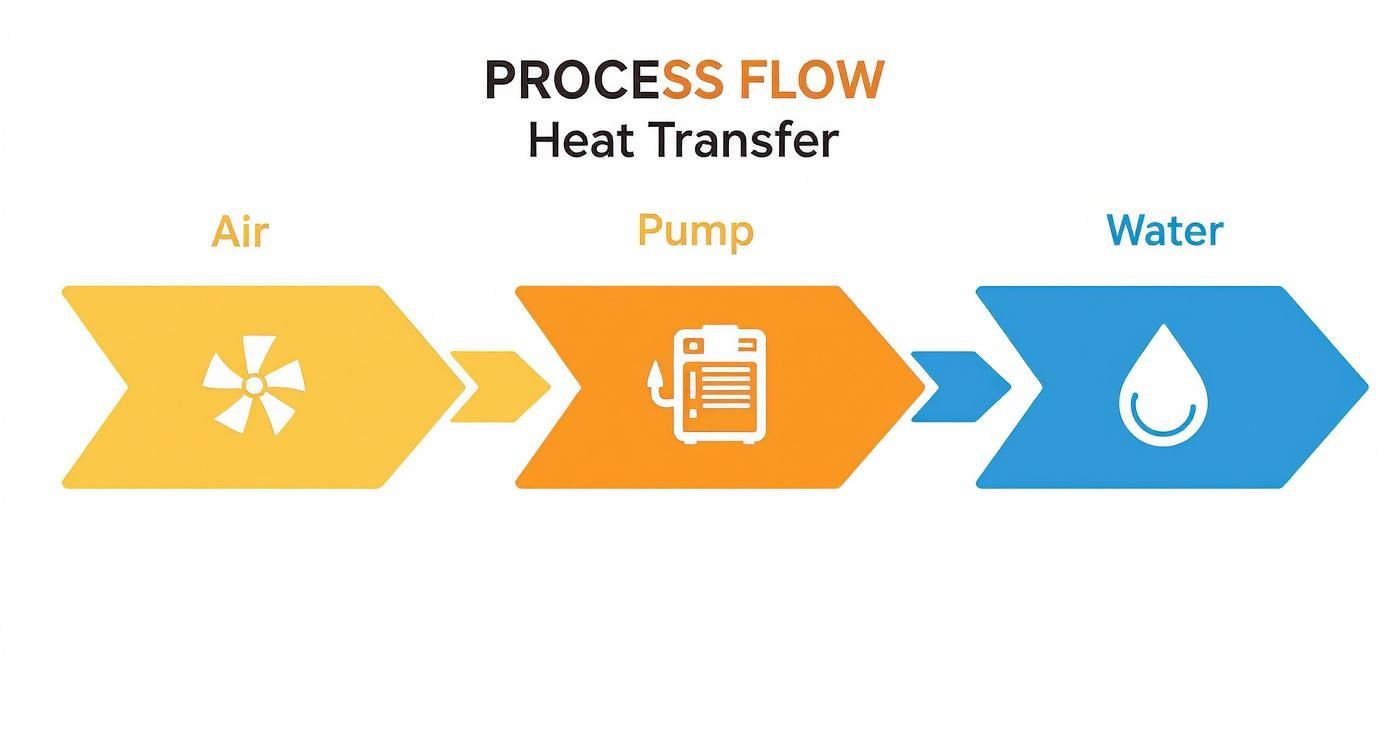
The most important thing to remember is that the system only uses a small amount of electricity to move heat, not to create it from scratch. That's the secret to its incredible efficiency.
This brilliant heat transfer system is the main engine, but it isn’t the only tool in the box. This is why you’ll often hear these units referred to as hybrid water heaters—they blend the super-efficient heat pump with a trusty backup system.
Tucked inside every heat pump water heater are traditional electric resistance heating elements, exactly like the ones in a conventional electric tank. Think of these as a turbo-boost, ready to jump in when your hot water demand suddenly spikes.
A hybrid water heater gives you the best of both worlds: exceptional energy savings for daily use and the on-demand power of electric elements for peak demand.
Most models let you choose how you want it to run, typically offering a few different modes:
This dual-system design makes the technology both smart and reliable. You get to enjoy significant energy savings every day without ever having to compromise on comfort. The unit’s internal thermostat handles the switch between modes seamlessly, adapting to your family's needs. Getting these settings dialled in correctly is a key reason why a professional touch is so important. For a deeper look at how our experts configure these systems for Muskoka homes, you can learn about our heat pump installation process.
When you’re looking at a big home upgrade like a new water heater, it always boils down to two things: what’s the ticket price, and what will it actually save me? It’s true, a heat pump water heater costs more to buy and install than a standard electric tank. But this is a classic case of the sticker price not telling the whole story.
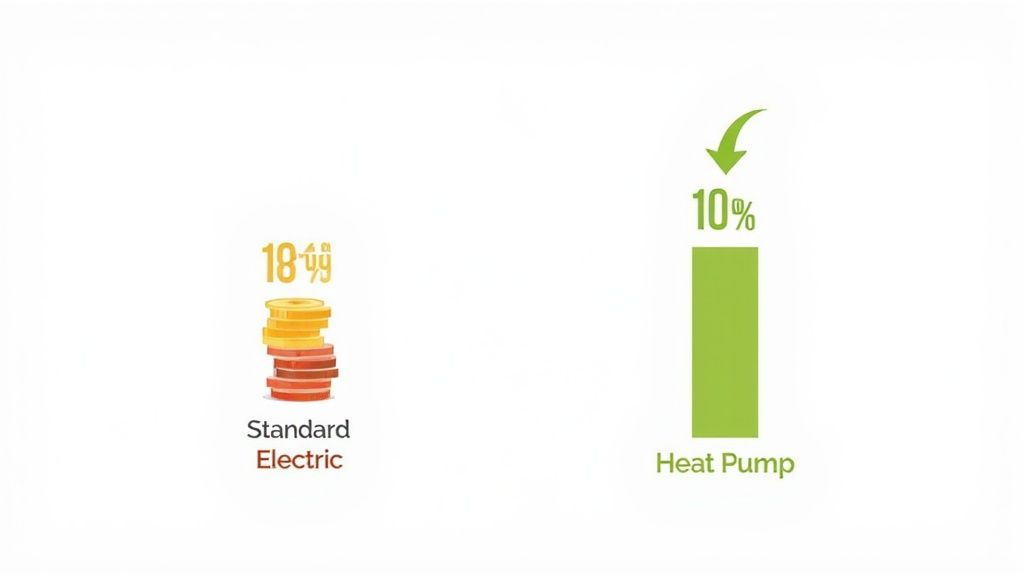
Think of the upfront cost as an investment in efficiency. That cheaper conventional electric tank might look appealing at first, but its inefficiency means you’re paying a premium on your hydro bill every single month. A heat pump water heater, on the other hand, starts putting money back in your pocket from the first bill through serious energy savings.
This shift towards long-term value is more than just a trend; it's becoming the standard. Energy codes are starting to favour these super-efficient units. For example, market data from California shows that the added cost for new homes to meet energy codes that require heat pump water heaters is about $940 per home. This signals a clear move towards smarter, more efficient home building.
So, how long until this investment pays for itself? The payback period is simply the time it takes for your energy savings to cover the extra upfront cost of the unit. For a typical family here in Muskoka, the math is surprisingly compelling.
With hydro rates being a big chunk of any household budget, slashing your water heating costs by up to 70% makes a huge difference. For an average family of four, we’re talking hundreds of dollars in savings every year.
The real story isn’t about the initial purchase price. It’s about the total cost of ownership over the next decade, and that’s where a heat pump water heater truly shines.
Let's walk through a realistic scenario. Say the installed cost difference between a heat pump unit and a standard electric one is about $2,000. If you're saving $500 per year on electricity, your payback period is just four years. After that, every dollar saved is pure return on your investment, year after year.
You can boost those savings even further by pairing your system with other smart home tech. Our guide on smart thermostat installations shows how you can get even more control over your home's energy use.
To really see the financial impact, let’s compare the estimated total cost of ownership over a decade for a typical Muskoka home. This includes the unit, the installation, and ten years of energy bills. The table below lays it all out.
Note: Costs are estimates for a typical family home in Muskoka and can vary based on usage, current hydro/fuel rates, and specific installation requirements.
The numbers make it pretty clear. The initial investment in a heat pump water heater pays off handsomely over the long run. Its incredible efficiency crushes its operating cost, making it the most economical choice over its lifespan.
While a natural gas heater is a strong contender where available, many Muskoka cottages and rural homes run on electricity or costly propane. For these properties, a heat pump water heater isn't just a good choice—it's the smartest one, offering the lowest total cost of ownership over ten years.
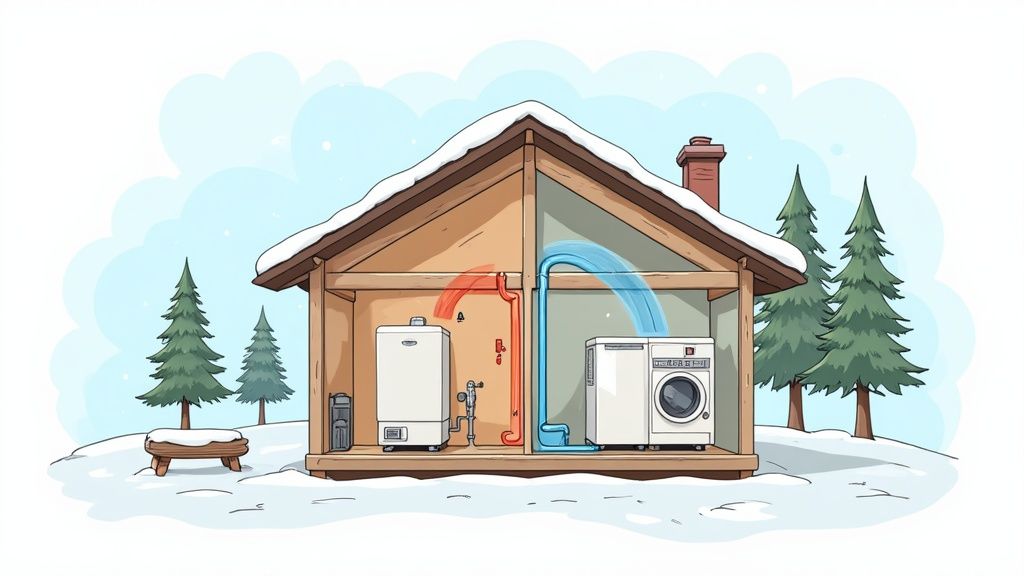
The efficiency numbers and potential savings are impressive, no doubt. But the real question is a local one: will a heat pump water heater actually work well in a Muskoka home or cottage? The answer is a resounding yes, but the secret lies in a smart installation that accounts for our climate and unique property layouts.
A heat pump water heater’s performance is directly linked to its environment. Because it pulls heat from the surrounding air, the ambient temperature is a big deal. This brings up a common, and very valid, concern for cottage country residents: can it still function in an unheated basement during a chilly Canadian winter?
Thankfully, today's units are built to handle it. Most modern heat pump water heaters can operate in temperatures as low as 5-7°C, which is well within the range of most insulated basements and utility rooms, even in the dead of winter. Efficiency will dip a bit as the air gets colder, but this is where an expert installation makes all the difference.
The perfect spot for a heat pump water heater gives it two things: a good volume of air to "breathe" and a steady source of ambient warmth. For the typical Muskoka property, a few locations are clear winners.
An unfinished or semi-finished basement is usually your best bet. These areas tend to stay above the minimum operating temperature and have plenty of air for the unit to pull from. Another great spot is a utility room that also contains a furnace. The furnace naturally gives off a small amount of waste heat, creating a slightly warmer micro-environment for the water heater to work in.
When we're scoping out a location, here's what we look for:
The main idea is to give the unit room to work. Proper placement ensures the heat pump can easily draw in warm air and push out the cooler, drier air without impacting its own performance or making your living space feel drafty.
Another practical point to consider is the sound. With a fan and a compressor running, a heat pump water heater isn't completely silent. The noise level is often compared to that of a new refrigerator or a quiet dishwasher, usually somewhere between 45 and 55 decibels.
While this is perfectly fine for a basement or a dedicated mechanical room, you probably wouldn't want it installed right next to a bedroom or your main living area. A good installer will help you pick a spot that minimizes any sound, keeping your home or cottage as peaceful as it should be. Proper water heater installation is about more than just connecting pipes—it’s about making the system a seamless part of your home.
This kind of careful planning helps overcome the hurdles that have slowed down adoption elsewhere. For example, a lack of awareness and worries about installation have been major barriers. In California, despite their incredible efficiency, these units still account for less than 1% of the water heater market. We make it easy by taking care of all these details for you.
https://www.youtube.com/embed/MqoPJeOpFiU
Let's be honest: the higher price tag of a heat pump water heater can be a bit of a hurdle, even with the promise of long-term savings. The good news is that you don't have to shoulder that cost alone. Government incentives are available specifically to help you clear that hurdle, making a smart energy upgrade a brilliant financial move.
Trying to figure out these programs on your own can feel like a part-time job. But between federal and provincial rebates for ENERGY STAR certified models, there's serious money on the table. Our job is to make sure you get every penny of it.
Right now, the big one for Ontario homeowners is the Canada Greener Homes Grant. This federal program is all about helping Canadians make their homes more energy-efficient, and a heat pump water heater is one of the star upgrades.
This grant can put a significant dent in your purchase and installation costs. The catch? It isn't as simple as just buying the unit. You need to follow specific steps, including getting a pre- and post-retrofit EnerGuide evaluation done. That’s where having an expert in your corner really pays off.
Navigating the maze of paperwork and eligibility rules for government grants can be a real headache. We handle the entire process for our clients. We make sure your application is done right the first time, so you get the maximum rebate without the stress.
This push to incentivize heat pump technology is part of a massive shift. Just look south of the border: over the past two decades in the U.S., heat pump sales have soared by about 115%, while traditional gas furnace sales have dropped. It's a clear sign of where home energy is headed. You can dig into the numbers yourself in a detailed market analysis on this trend.
Getting your hands on these savings is a step-by-step process, and we walk you through it from start to finish. Here’s a quick look at what the journey typically involves for a program like the Canada Greener Homes Grant:
Following this checklist ensures nothing gets missed. Because we've done this hundreds of times, we know exactly what paperwork is needed and how to submit it properly, taking all the guesswork and stress off your shoulders. We’re here to help you turn a great investment into an incredible one.
Alright, we've covered the technology, the savings, and the rebates. Now let's get down to brass tacks: what's it really like to have one of these in your home or cottage day-to-day? These are the practical questions we hear most often from homeowners right here in Muskoka, and we’ve got straightforward answers for you.
This is usually the first thing people ask. Since a heat pump water heater has a compressor and fan working to pull in heat, it’s not completely silent like your old electric tank. The sound is best compared to a modern, quiet dishwasher or your refrigerator—typically in the 45 to 55 decibel range.
For most installations in a basement, cottage crawlspace, or utility closet, the sound is barely noticeable. You just wouldn’t want it installed in a closet right beside a bedroom. A good installer will work with you to find the perfect spot that keeps your home the peaceful retreat it’s meant to be.
Here's some good news: maintaining a heat pump water heater is surprisingly easy. It’s very similar to caring for a standard tank, with just one extra step.
Think of it like your furnace—it has an air filter that needs a bit of attention to keep everything running smoothly.
That’s pretty much it. A few minutes of simple care a few times a year will keep your system in top shape.
Taking care of your heat pump water heater is the single best way to protect your investment. A little bit of routine maintenance goes a long way in ensuring you get the best performance and longest life out of your unit.
Investing in a new piece of equipment for your home means you expect it to stick around for a while. You can expect a heat pump water heater to last 10 to 15 years, which is on par with, and often even longer than, a typical electric or gas water heater.
Of course, its actual lifespan will depend on things like your local water quality and how consistently you keep up with maintenance. But with proper care, these units are built to be reliable workhorses, delivering energy-efficient hot water for more than a decade.
Ready to see if a heat pump water heater is the right choice for your Muskoka home? The team at Bridlewood Mechanical specializes in energy-efficient solutions and can guide you through every step, from choosing the right unit to maximizing your rebates. Contact us today for a transparent quote.Learn more at https://bridlewoodmechanical.ca









Free, no-obligation quote
Tell us what's going on with your heating, cooling or water heater and we'll follow up to book a visit.
Prefer to talk? Call us directly(705) 706-7622Thanks, we've got your request.
We'll be in touch shortly. Need us sooner? Call (705) 706-7622.
Sorry, that didn't send. Please try again or call (705) 706-7622.
Service Tankless Water Heater: The Pro's Maintenance Guide
Repair Heating System: When DIY Isn't Enough
Discover our dedication to delivering tailored, high-quality HVAC solutions.
Copyright © Bridlewood Mechanical 2025 | Designed By Vodata Digital


