


Service Tankless Water Heater: The Pro's Maintenance Guide
Service Tankless Water Heater: The Pro's Maintenance Guide
Read more



Free, no-obligation quote
Tell us what's going on with your heating, cooling or water heater and we'll follow up to book a visit.
Prefer to talk? Call us directly(705) 706-7622Thanks, we've got your request.
We'll be in touch shortly. Need us sooner? Call (705) 706-7622.
Sorry, that didn't send. Please try again or call (705) 706-7622.
When you invest in a heat pump, one of the first questions is always, "How long will this thing actually last?" Generally speaking, you can expect a well-maintained system to serve you for anywhere from 12 to 20 years.
But that's a pretty wide range, isn't it? The real answer depends heavily on the type of system you have, the quality of its installation, and how well you maintain it. For example, a geothermal heat pump often has a much longer lifespan than its air-source cousin, which is a major factor when you're thinking about the long-term value for your home or cottage.

Think of your heat pump like a car. If you drive it carefully and get regular oil changes, it's going to run smoothly for years. The same logic applies here—a heat pump's durability is a direct result of its type, the quality of the initial installation, and how well you take care of it over time.
For those of us in Canada, and especially in areas like Muskoka that see serious winter weather, this isn't just about keeping cozy. It's about having a reliable system you can count on when the temperature plummets. A heat pump's lifespan isn't a fixed guarantee; it’s a potential you unlock with the right choices and consistent upkeep, and a professional partner like Bridlewood Mechanical can help you maximize it.
Not all heat pumps are built the same, and their lifespans can vary quite a bit. Air-source heat pumps, the kind you typically see mounted outside a house, are constantly exposed to rain, snow, and fluctuating temperatures. Naturally, that exposure leads to more wear and tear.
Geothermal systems, on the other hand, have their most important components safely buried underground, shielded from the elements.
Here's the key takeaway: while air-source units are a fantastic and popular choice, geothermal systems are in a league of their own for durability. They're engineered to last for generations, which is a huge part of understanding their long-term value.
To make this a bit clearer, let's break down the average lifespans you can expect from the most common types of heat pumps.
Here’s a summary of the expected operational lifespan for the most common types of heat pumps found in Canadian homes, based on typical usage and proper maintenance.
As you can see, the difference is significant. The indoor components of a geothermal system can easily last over two decades, while the underground piping—the ground loop—can last for 50 years or more. It truly is a long-term solution.
Ever wondered why your neighbour’s heat pump is still humming along after 20 years, while another one down the street gave up the ghost in less than 10? It’s almost never just bad luck. A few key factors are always at play, determining just how long your system will keep your home comfortable.
Think of it like a car. The sticker on the window doesn't guarantee how many kilometres it'll last. How it's driven, where it's driven, and how well it's maintained are what really count. It's the same story for your heat pump.
The single most important day in your heat pump's life is the day it’s installed. Seriously. A shoddy installation is a recipe for disaster, causing everything from sky-high energy bills and constant breakdowns to a dramatically shorter lifespan.
If a unit is too small for your home, it will run itself ragged trying to keep up. If it's too big, it will constantly cycle on and off, putting massive wear and tear on the components. This is where professional expertise isn't just a nice-to-have; it's essential. The team at Bridlewood Mechanical sizes, connects, and tunes every component specifically for your home. It’s this attention to detail that lays the groundwork for years of reliable service.
Once your heat pump is up and running, consistent, professional maintenance is the best thing you can do for it. Forgoing an annual tune-up is like refusing to change the oil in your car—it might seem fine for a while, but you’re heading for a major, costly breakdown.
A heat pump works incredibly hard, season after season. An annual service call lets a technician clean the coils, check refrigerant levels, secure electrical connections, and lubricate all the moving parts. This keeps the system running smoothly and efficiently, preventing the kind of strain that kills a unit years before its time.
Treat it as preventative medicine for your home comfort system. Our maintenance plans are designed to catch small issues before they become expensive problems, making this small yearly investment your best bet for getting the most life out of your unit.
Where you live and how you use your heat pump matter, too. Here in Canada, our systems are put through their paces, battling frigid winters and then switching gears for hot, humid summers. That constant demand puts a lot more stress on key parts, like the compressor, than it would in a more temperate place.
Heat pumps in a place like California, for example, often last 15 to 20 years because the mild winters don’t push the heating components nearly as hard. You can read more about how heat pumps perform in gentler climates on JaguarHeatingAndAir.com.
Your day-to-day habits also have an impact. Constantly cranking the thermostat up and down forces the system into overdrive. A much better approach is to use a programmable or smart thermostat to maintain a steady, efficient schedule that reduces that strain. If you don't have one, looking into professional smart thermostat installations is a smart move to help your system run better and last longer.
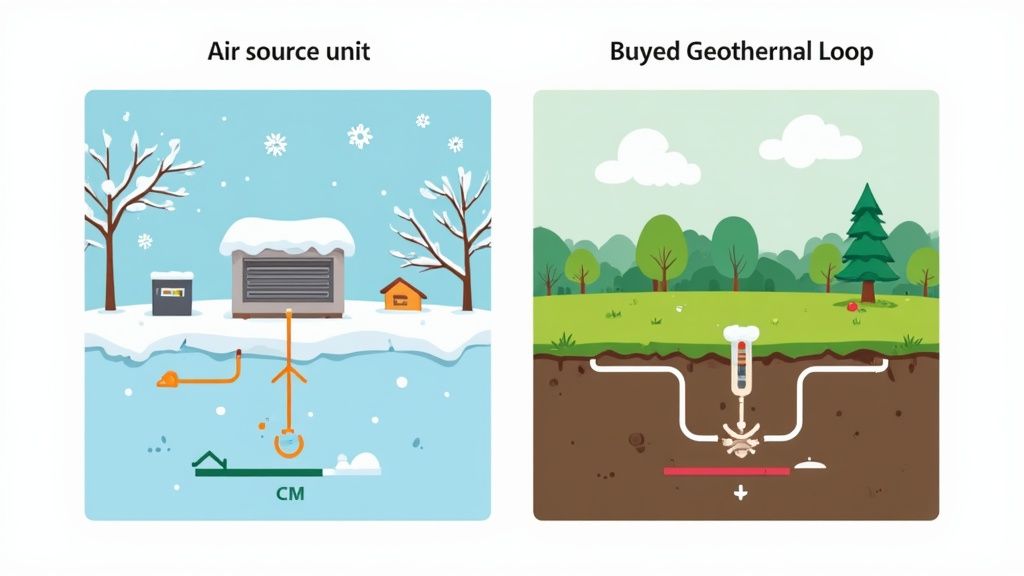
When you're trying to understand the lifespan of a heat pump, it helps to picture two different scenarios. In one, you have a workhorse of a machine constantly out in the elements. In the other, you have a system that’s almost completely sheltered from the storm.
That's the fundamental difference between an air-source heat pump and a geothermal system, and it's the single biggest factor behind their dramatically different lifespans.
An air-source heat pump’s outdoor unit is in a constant battle with the Canadian climate. We’re talking heavy snowfalls, freezing rain, summer humidity, and everything in between. This relentless exposure inevitably leads to more wear and tear on its most critical parts.
Geothermal systems, on the other hand, have their most durable components—the underground loops—safely buried deep in the earth. Shielded from harsh weather, these parts are protected from the daily physical stress that an air-source unit has to endure.
This built-in protection gives geothermal systems an incredible advantage in longevity. The indoor components can easily last for 20-25 years, but the underground loop system? That often has a functional lifespan of 50 years or more. It's less of a purchase and more of a generational investment in your property.
Of course, that doesn't mean air-source models are flimsy. Far from it. A well-maintained heat pump, including the increasingly popular ductless mini-splits, can often outlast a traditional air conditioner. Many systems easily hit the 15 to 20-year mark. Because they handle both heating and cooling, the operational wear is spread more evenly throughout the year, which actually contributes to their durability.
The key difference is the environment. An air-source unit is built to withstand the weather, but a geothermal unit is built to avoid it entirely. This fundamental design choice is what separates a 15-year lifespan from a 50-year one.
This impressive durability extends to specific types of air-source systems, too. For example, many homeowners are turning to the efficiency and flexibility of ductless heating and cooling systems, which can push past 20 years with proper care.
So, how do you choose? It really comes down to balancing the upfront investment with the long-term returns. Geothermal requires a significant initial cost for installation and excavation, but it pays you back over decades with unparalleled longevity and incredibly low operating costs.
Air-source systems provide a much more accessible entry point, delivering fantastic efficiency and reliability for a lower upfront investment. To make the decision a bit clearer, let's compare them directly.
Here’s a side-by-side look at the key differences between air-source and geothermal heat pumps, focusing on expected lifespan, installation costs, and long-term maintenance considerations.
Ultimately, both are excellent technologies. The "best" one for you depends on your budget, your property, and how long you plan to stay in your home. Our team can provide a detailed quote and energy-saving analysis for both options to help you make an informed choice.
A heat pump rarely just gives up the ghost overnight. Like an old car that starts making strange noises, your system will usually give you plenty of hints that it's struggling long before it completely breaks down.
Learning to spot these red flags is your best defence against a sudden and expensive failure, especially when a harsh Muskoka winter is just around the corner. Ignoring these symptoms is like putting tape over your car's check engine light—the problem isn't going away, and it's likely getting worse.
One of the first and most obvious signs of a dying heat pump shows up on your monthly hydro bill. When a heat pump's components get old and worn, the whole system loses efficiency. It has to run harder and longer just to keep your home at the temperature you’ve set.
We're not talking about a small jump, either. If you see your heating or cooling costs shoot up by 25% or more compared to the same time last year, and your habits haven't changed, that's a major red flag. Your heat pump is essentially screaming for help by burning through energy just to keep up.
You know the normal sounds of your home, including the gentle hum of your heat pump cycling on and off. So, when new and alarming noises start cropping up, it's time to listen closely. These sounds often point directly to specific mechanical issues that can signal the system is on its way out.
Keep an ear out for these tell-tale sounds:
Think of these noises as a cry for help. A healthy heat pump should be a quiet, background hum. A system in distress will make its problems known loud and clear. A quick service call from our expert technicians can tell you if it's a simple fix or a sign of a much bigger problem.
Another clear sign of trouble is when your home just doesn't feel comfortable anymore. Maybe you notice that some rooms are stuffy and hot while others are chilly, or the system just can't seem to hit the temperature you set on a really cold day.
This kind of inconsistent performance is a classic symptom of a heat pump that's losing its heating and cooling capacity. It often happens when a critical component, like the compressor, is starting to fail. If you're constantly fiddling with the thermostat just to feel comfortable, your heat pump is probably waving a white flag. Catching these signs early is the key to understanding how long your heat pump will last and planning your next move.
When your heat pump suddenly gives up, you’re stuck with a big question: shell out for a repair, or is it time to bite the bullet and invest in a whole new system? Seeing a hefty repair quote can be a shock, but making a snap decision out of frustration might cost you a lot more down the road.
The right choice isn't always obvious. A relatively new system might just have a small, affordable part that needs swapping out, making a repair a no-brainer. On the other hand, sinking good money into an old, clunky unit that’s just going to fail again in a few months is a classic case of throwing good money after bad. Having a solid framework can make all the difference.
Here’s a handy rule of thumb we use in the HVAC industry to help homeowners see things clearly: the 50% rule. It’s a quick calculation that helps you weigh the financial side of your decision.
Here's how it works: take the estimated cost of the repair and multiply it by the age of your heat pump in years. If that number is bigger than the cost of a brand-new replacement system, it’s probably smarter to replace it.
For example, let's say you have a 12-year-old heat pump that needs a $500 repair. You'd do the math: $500 x 12 = $6,000. If a new, high-efficiency heat pump costs less than $6,000 to install, replacement is the better long-term investment.
Of course, this isn't a hard-and-fast law, but it gives you a great starting point for thinking through the numbers.
Sometimes, a repair is absolutely the right call. If your system is still on the younger side—less than ten years old—and you've kept up with maintenance, a one-off fix for a minor issue is often the way to go.
The key is getting a professional diagnosis. A technician you trust can tell you if you're dealing with a simple fix or if this is the first sign of a much bigger problem brewing inside the unit. At Bridlewood, we always provide a transparent assessment to help you make the best choice, not just the most expensive one.
On the flip side, if your heat pump is pushing past the 12-15 year mark, a major repair is often just putting off the inevitable. This is when you should seriously start looking at a replacement. Today's heat pumps are light-years ahead of older models in terms of energy efficiency. A new unit can start saving you a noticeable amount on your monthly hydro bills right away.
This infographic breaks down some of the most common warning signs that push homeowners into this exact repair-or-replace dilemma.
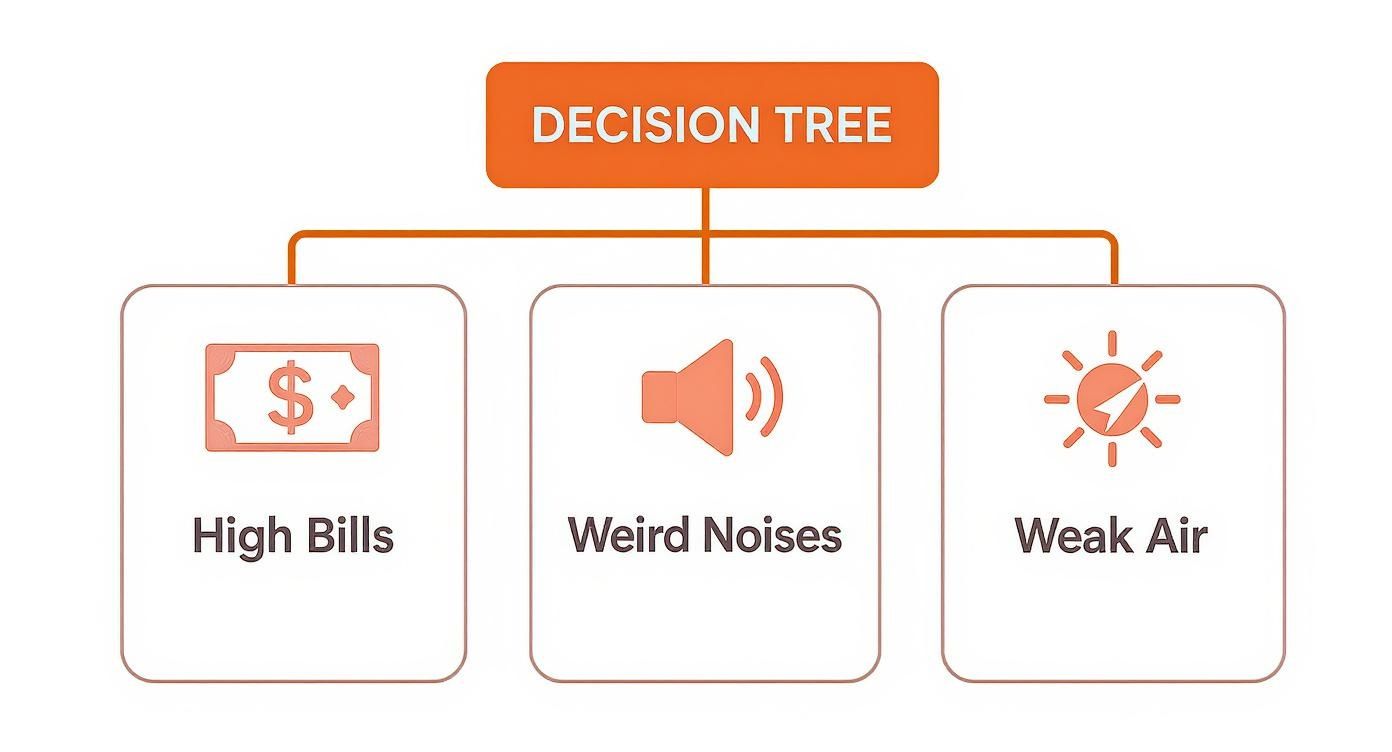
As you can see, plummeting efficiency, strange noises, and weak performance are the top reasons people look to replace. Interestingly, recent studies are finding that well-maintained systems are outlasting their old life expectancies. A 2023 analysis discovered that about 93% of heat pumps up to 20 years old were still running, blowing past the traditional 15-year estimate. You can read the full research about these heat pump findings for yourself.
Ultimately, the best way to get clarity is with an honest assessment from the experts here at Bridlewood Mechanical. We’ll give you a straight-up diagnosis and walk you through all your options—no pressure, just clear information so you can make a confident choice for your home.

So, how long will your heat pump actually last? When you boil it all down, it really depends on three key things: getting the initial setup right, keeping up with preventative care, and having access to expert repairs when something goes wrong. Think of it like a three-legged stool—if one leg is shaky, the whole thing gets wobbly. To protect your investment, you need a partner who nails all three.
At Bridlewood Mechanical, we're not just installers; we see ourselves as your long-term partner in home comfort. Our commitment starts right from the beginning with a meticulous system design and installation. We make sure your unit is perfectly sized and calibrated for your home, because that foundational step is what prevents the needless wear and tear that can slash years off a system's life.
Our relationship doesn't end once the unit is up and running. We firmly believe that proactive care is the single best way to get the most out of your heat pump, both in terms of lifespan and efficiency. That’s why we’ve designed our preventative maintenance plans to keep your system humming along perfectly, season after season.
A heat pump is a complex machine that works hard all year round. An annual tune-up isn't just a recommendation—it's the best insurance policy you can buy for its long-term health and reliability.
We take care of all the crucial jobs that promote longevity:
This dedicated service does more than just extend the life of your equipment. It helps keep your energy bills in check and ensures your home stays comfortable, no matter what the weather is doing outside. And when you're ready to invest in a new system, our professional heat pump installation and our know-how in navigating government rebates mean you get the best possible value from the start.
We've walked through the big factors that influence how long your heat pump will last, but you probably still have a few lingering questions. Let's dig into some of the most common ones we hear from our neighbours right here in the Muskoka region.
This is a great question, and the answer really depends on the type of heat pump we're talking about.
For a standard air-source heat pump, getting 25 years out of it in our climate is a real stretch. With our cold winters forcing it to work hard, you're more realistically looking at a lifespan of 12 to 15 years.
A geothermal system, on the other hand, is a completely different beast. The indoor components can easily last 20-25 years, and the underground loops are built to last for 50 years or even longer. It’s a true generational investment in your home.
You can typically expect a professional tune-up for your heat pump to run somewhere between $150 and $300. But it's best to think of this as an investment, not just another bill.
That small yearly cost is your number one defence against a surprise breakdown and a much larger repair bill. It keeps your system running as efficiently as possible, which means the energy savings often pay for the service call itself over the course of a year.
Simply put, a well-cared-for unit has the best shot at reaching its full potential lifespan. Contact us to learn more about our affordable and comprehensive maintenance plans.
It's a common myth, but no, not really. Heat pumps are actually designed to run for longer, steadier cycles compared to old-school furnaces. It’s the constant stop-and-start of short cycling that puts immense strain on the compressor, which is the heart of the whole system.
Letting your heat pump maintain a steady temperature is far healthier for the unit than fiddling with the thermostat and causing big temperature swings. That consistent operation is exactly what it was engineered for, and it’s the key to a long and happy service life.
Ready to get the most out of your heat pump or look into a high-efficiency upgrade? The team at Bridlewood Mechanical has the local expertise you need for reliable installations, maintenance, and repairs that keep you comfortable for years to come.
Visit us at https://bridlewoodmechanical.ca to book your appointment.









Free, no-obligation quote
Tell us what's going on with your heating, cooling or water heater and we'll follow up to book a visit.
Prefer to talk? Call us directly(705) 706-7622Thanks, we've got your request.
We'll be in touch shortly. Need us sooner? Call (705) 706-7622.
Sorry, that didn't send. Please try again or call (705) 706-7622.
Service Tankless Water Heater: The Pro's Maintenance Guide
Repair Heating System: When DIY Isn't Enough
Discover our dedication to delivering tailored, high-quality HVAC solutions.
Copyright © Bridlewood Mechanical 2025 | Designed By Vodata Digital


