


Service Tankless Water Heater: The Pro's Maintenance Guide
Service Tankless Water Heater: The Pro's Maintenance Guide
Read more




Free, no-obligation quote
Tell us what's going on with your heating, cooling or water heater and we'll follow up to book a visit.
Prefer to talk? Call us directly(705) 706-7622Thanks, we've got your request.
We'll be in touch shortly. Need us sooner? Call (705) 706-7622.
Sorry, that didn't send. Please try again or call (705) 706-7622.
Watching your heating bills skyrocket during a harsh Canadian winter is a feeling most of us know all too well. For a long time, the only options were traditional furnaces that burned expensive oil, propane, or natural gas. But what if you could keep your home perfectly warm and comfortable while making a serious dent in your energy consumption and fuel costs?
That's exactly what a professionally installed, modern cold-climate heat pump is designed to do. At Bridlewood Mechanical, we specialize in helping homeowners make this smart upgrade, transforming their home's efficiency and comfort.
If you've heard the old myth that "heat pumps don't work where it gets really cold," it's time to set the record straight. Today's systems are a world away from their predecessors, engineered from the ground up to handle our climate. They represent a massive leap forward in home heating technology.
The magic is in how they work. Instead of creating heat by burning fuel, they cleverly move it. Using advanced technology, they extract existing heat from the outside air—even when it's frigid out—and transfer it inside your home.
This process is incredibly efficient. Consider this: the best high-efficiency furnace you can buy is maybe 95-98% efficient. A cold-climate heat pump, on the other hand, can operate at efficiencies between 200% and 400%.
How is that possible? Because it’s not creating heat, just moving it. For every one unit of electricity it uses, it can deliver two to four units of heat into your home. That level of performance leads directly to much lower monthly energy bills and a significantly smaller carbon footprint for your family.
Let's break down the advantages.
Here’s a clear look at how modern heat pumps stack up against the furnaces we’re all used to.
This outstanding efficiency and all-in-one functionality make choosing one of the best heat pumps for cold climates a smart, forward-thinking investment.
When our experts pair your system with the right controls, you can push those savings and comfort levels even further. You can learn more about how our smart thermostat installations integrate perfectly with these modern systems to create a home that’s truly responsive to your needs.
It seems a bit like magic, doesn't it? Pulling heat out of the air when it's already freezing outside. But it's all clever engineering. The biggest myth we hear is that cold air has no heat left to give. The truth is, thermal energy exists in the air all the way down to absolute zero (-273°C). So even on a biting-cold Canadian winter day, there’s still plenty of heat for a modern heat pump to work with.
Think of the special refrigerant inside the system as a high-tech sponge. When it gets pumped to the outdoor unit, it’s engineered to be extremely cold—much colder than the winter air. Since heat always moves from a warmer place to a cooler one, that super-chilled refrigerant easily soaks up the heat energy from the surrounding air, just like a dry sponge soaks up water.
From there, the now "charged" refrigerant travels to the indoor unit, where it gets put under pressure. Compressing it concentrates all that absorbed heat, which dramatically raises its temperature. A fan then blows your home's air over the hot coils, transferring all that wonderful warmth into your living space. This elegant cycle of moving heat, instead of creating it from scratch like a furnace does, is the secret to their incredible efficiency.
The following infographic breaks down how this efficient operation translates into real-world benefits like lower energy bills and a more comfortable home.
As you can see, the technology isn't just theory; it directly creates a more efficient and comfortable way to heat your home, making it a powerful choice for our winters. So, what are the specific features that let these machines perform so well when the temperature really plummets?
Older heating systems are a bit like a light switch: they’re either on at full blast or completely off. That constant, jarring on-off cycle is wildly inefficient and creates those annoying temperature swings inside your house. It’s like trying to drive at a steady 100 km/h by flooring the gas and then slamming on the brakes over and over again.
Modern cold-climate heat pumps, on the other hand, use inverter-driven (or variable-speed) compressors.
Instead of just shutting off, an inverter-driven compressor simply slows down or speeds up, precisely matching your home's heating needs from moment to moment. This is the real key to delivering both exceptional efficiency and perfectly consistent comfort.
This smarter technology allows the system to run for longer periods at a very low power draw, sipping electricity instead of guzzling it. It’s this ability to constantly adjust its output that makes it one of the most critical features in any top-tier heat pump designed for cold climates.
If the inverter is the brains of the operation, Enhanced Vapour Injection (EVI) is the muscle that gets it through the deep freeze. This is a game-changing technology that allows a heat pump to keep its heating power and efficiency even at temperatures far below zero, often right down to -25°C and beyond.
You can think of EVI as a kind of turbocharger for the heat pump. It works by injecting a tiny bit of extra refrigerant vapour into the compressor at a critical stage in the cycle. This "two-stage" boost supercharges the system's ability to pull heat from frigid air and deliver much hotter air inside your home.
Here’s what EVI technology brings to the table:
When you put them together, the inverter-driven compressor and EVI technology are a powerhouse duo. They give a cold-climate heat pump the intelligence to run efficiently and the strength to handle anything a Canadian winter can throw at it, keeping your home warm and your energy bills down.
When you start digging into heat pump spec sheets, it can feel like trying to read a foreign language. All those acronyms and numbers can be overwhelming, but they're the key to seeing past marketing hype and finding a unit that will actually keep you warm when the temperature plummets. Getting a handle on these terms lets you choose a system that delivers real savings and reliable comfort.
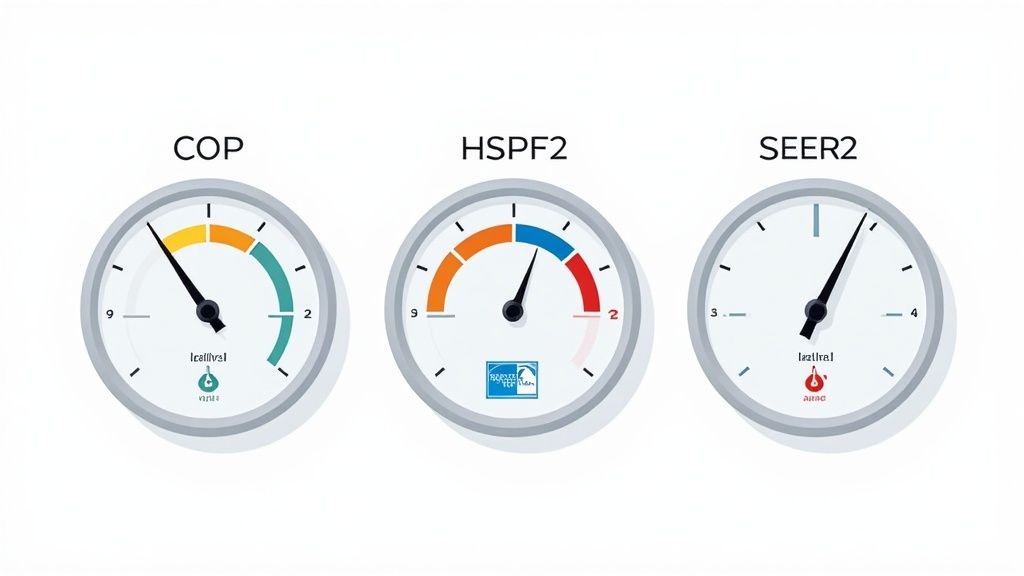
Think of it like buying a car. You wouldn't just look at the top speed; you'd check the fuel efficiency for both city and highway driving to get the full story. Heat pump metrics are the same—they tell you how efficiently the machine runs across different seasons and conditions.
The two ratings you'll encounter most often are HSPF2 and SEER2. These are the big-picture numbers that give you a sense of how a unit will perform over an entire heating or cooling season.
HSPF2 (Heating Seasonal Performance Factor): This is your winter efficiency score. It’s a measure of the total heat the unit provides over the heating season versus the total electricity it uses. A higher HSPF2 means lower heating bills. Simple as that.
SEER2 (Seasonal Energy Efficiency Ratio): This is the summer equivalent, measuring cooling efficiency. Just like with HSPF2, a bigger SEER2 number means better efficiency and lower costs to run your air conditioning.
These seasonal ratings are great for estimating your potential annual energy savings. But for a Canadian climate, they don't tell the whole story. To really know how a heat pump will handle a deep freeze, we need to look a little closer.
While seasonal ratings are useful, the single most critical metric for judging the best heat pumps for cold climates is the Coefficient of Performance (COP). This isn't an average over a whole season; it's a real-time snapshot of the unit's efficiency at a specific outdoor temperature.
The Coefficient of Performance tells you how many units of heat the system produces for every single unit of electricity it consumes at that moment. For example, a COP of 3.0 means the heat pump is delivering three units of heat for every one unit of electricity, making it 300% efficient.
For comparison, a standard electric baseboard heater always has a COP of 1.0 (or 100% efficient). A high-performance cold-climate heat pump, on the other hand, can maintain a COP of 2.0 or higher even when it's as cold as -15°C. This is the number that proves a heat pump can heat your home effectively and affordably when you need it most. When you're comparing models, our experts can walk you through the COP ratings at low temperatures, not just the mild-weather figures.
Trying to compare all these technical specs can be a headache. Luckily, there’s an easier way to find units that have been third-party tested and verified to perform in our climate: the ENERGY STAR for Cold Climate certification.
This label isn't just a marketing sticker; it's your guarantee that a heat pump meets tough performance standards designed specifically for regions like ours.
To earn the ENERGY STAR Cold Climate certification, a heat pump must:
Looking for this certification is the most reliable shortcut to finding a quality system. It instantly narrows your search to a list of proven models. From there, an expert technician from Bridlewood Mechanical can help you match the right certified model to your home's unique needs, ensuring you invest in one of the best heat pumps for cold climates on the market.
Alright, you've learned how to decode a spec sheet. Now comes the fun part: figuring out which type of heat pump actually makes sense for your home. This isn't a one-size-fits-all situation; the right system for a century-old farmhouse will be completely different from what works best in a modern suburban build.
It all boils down to your home's layout, how you live in it, and your budget. Let's walk through the main options you'll encounter.
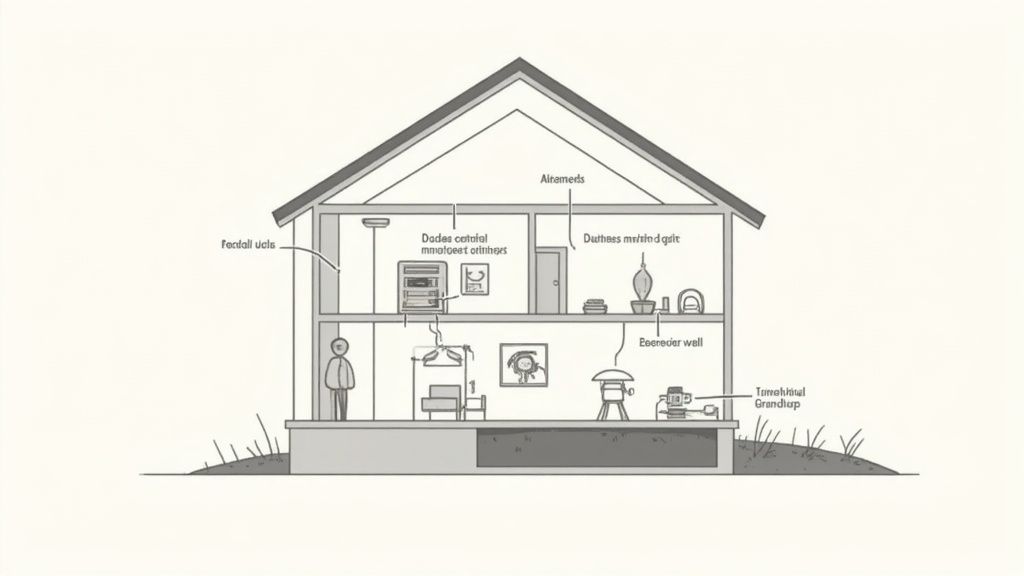
Think of this as matchmaking for your house. Getting a feel for each system's strengths and weaknesses is the key to making a choice you'll be happy with for years to come.
If you currently have a furnace and central air conditioning, you've already got the most important piece of the puzzle: ductwork. In this case, a ducted heat pump is almost always the most direct and budget-friendly path forward.
The setup will feel familiar. It uses an outdoor unit connected to an indoor air handler, which then uses your existing ducts to deliver warm or cool air throughout the house. It’s a true whole-home solution that gives you that consistent, even temperature you’re used to, all managed from a central thermostat. It’s the perfect swap for an aging furnace.
But what if you don't have ducts? Many older homes, cottages, and houses with additions were built with baseboard heaters or a wood stove, making ductwork a non-starter. This is where a ductless mini-split system truly shines.
These setups involve an outdoor unit that connects to one or more indoor "heads," which are typically mounted high on a wall. The magic is that each indoor head has its own remote, letting you create independent temperature zones. You can crank the heat in the living room for a cozy movie night while keeping the empty spare bedroom cool, which is a game-changer for energy savings.
We often recommend them for open-concept spaces or any home where installing a full duct system would be a nightmare. You can learn more about how a ductless heating and cooling system could be the perfect fit for your home.
Mini-splits offer incredible zoning capabilities. By placing indoor units strategically, you can direct heating and cooling exactly where it's needed most, eliminating hot and cold spots and maximizing both comfort and efficiency.
For those who want the absolute gold standard in efficiency, geothermal heat pumps are in a league of their own. Sometimes called ground-source systems, they don't pull heat from the ever-changing outside air. Instead, they tap into the remarkably stable temperature of the earth itself.
A series of pipes, called a ground loop, is buried on your property where the temperature holds steady at about 7°C to 12°C all year. Because it’s working with this consistent source, the heat pump barely breaks a sweat to warm your home in winter or cool it in summer. The upfront cost is much higher—you're paying for excavation, after all—but the rock-bottom operating costs and incredible lifespan mean they often pay for themselves over time.
For absolute confidence during the deepest, darkest days of a Canadian winter, a hybrid system (also called a dual-fuel system) is tough to beat. This smart setup pairs a new, high-efficiency cold-climate heat pump with a gas or propane furnace.
Here’s how it works: the heat pump does all the heavy lifting for most of the year—throughout the fall, spring, and all but the most frigid winter days. But when the temperature really plummets to a set point, say -15°C, the system automatically hands off the heating job to the furnace. You get the incredible efficiency of a heat pump for 95% of the heating season, with the raw power of a furnace as an infallible backup.
Deciding between these options really comes down to your property, your priorities, and your budget. This table lays out the key differences to help you see which one might be the best match.
Each system has a clear purpose. A ducted system is a logical upgrade, a ductless system offers unmatched flexibility, geothermal provides ultimate efficiency, and a hybrid system delivers bulletproof peace of mind. Our team can help you decide which path is right for you.
https://www.youtube.com/embed/ARAuZApzDZA
Picking out a high-quality, efficient cold-climate heat pump is a great start. But the real magic—the part that unlocks all the savings and comfort—happens during the installation. A system that’s installed poorly will never live up to its potential, no matter how impressive the specs are on the box. This is one of those times when calling in a professional is absolutely essential.
Think of it this way: expert installation is the bridge between the incredible technology you've purchased and how it actually performs on a frigid January night. It’s what ensures your investment pays you back for years and years.
More than anything else, two things will make or break your heat pump's performance: how it's sized for your home and where the outdoor unit is placed. If you get either of these wrong, you're setting yourself up for an inefficient system, uncomfortable rooms, and even a shorter lifespan for the unit.
A true professional never guesses. We perform what's known as a Manual J calculation. This is the industry-standard method for figuring out exactly how much heating and cooling your specific home needs. It takes everything into account—your insulation, the quality of your windows, your home's layout, and even which way it faces. This detailed analysis guarantees the unit is strong enough for the worst winter days but isn't so big that it wastes energy on milder ones.
Where the unit lives outside is just as critical, especially here in Canada.
We see this all the time: an outdoor unit placed right under a roofline where snow and ice come crashing down, or in a spot where drifts pile high. A seasoned installer knows to scout out a location that's sheltered and elevated, protecting your investment and letting it run at peak efficiency all winter long.
When you're budgeting for a new heat pump, it's important to look beyond the price tag on the unit itself. Being upfront about the total investment helps you plan properly and understand the real value you're getting. Your final quote will usually be made up of a few key parts.
A Typical Cost Breakdown:
The best way to get a clear, all-in number is to work with a local company you trust. At Bridlewood Mechanical, we provide detailed, transparent quotes that break down every part of your heat pump installation. There are no surprises or hidden fees, so you have total clarity from day one.
Here’s the best part: upgrading to a high-efficiency heat pump comes with serious financial perks. Both the federal and provincial governments offer major rebates to encourage homeowners to switch to cleaner heating. These programs can slash your initial cost, often by thousands of dollars.
But trying to figure out the rebate process on your own can be a headache. The rules, deadlines, and qualifying models seem to change constantly. This is another spot where having an experienced partner is a game-changer. We keep track of all the available programs, guide you to an eligible system, and handle the paperwork to get the maximum rebate you're entitled to. We turn a confusing process into a simple and rewarding final step.
Making a big change to your home's heating system naturally comes with a few questions. Let's tackle the most common ones we hear from homeowners about switching to a cold-climate heat pump.
Yes, it absolutely will. This isn't the heat pump technology of a decade ago. Today’s best cold-climate heat pumps are engineered specifically for tough Canadian winters, reliably producing heat in temperatures as low as -25°C or even -30°C.
They pull this off using sophisticated tech like inverter-driven compressors and vapour injection, which lets them keep working efficiently even in a deep freeze. Of course, on the most frigid days of the year, their output might dip slightly. That’s why every system we design includes a backup heat source—either small electric elements or your existing furnace—that automatically kicks in for a short time to cover the gap. You won't even notice it happen; your home will just stay perfectly comfortable.
This is the big one, and while it depends on what fuel you're replacing and local electricity rates, the savings are almost always substantial. The best heat pumps for cold climates are often over 300% efficient. Think about that for a second: for every one unit of electricity you pay for, you get three units of heat moved into your home.
To put that in perspective, electric baseboards are 100% efficient (one unit in, one unit out), and even a top-tier natural gas furnace maxes out at around 95% efficiency. Most homeowners who make the switch from oil, propane, or electric resistance heat see their annual heating costs fall by 30% to 60%.
Not at all. The upkeep is very similar to what you'd expect from a standard furnace and air conditioner. As a homeowner, your main tasks are simple:
Beyond that, we strongly recommend a yearly tune-up with a certified pro. A technician will give the coils a deep clean, verify refrigerant levels, and check all the electrical connections to ensure it’s running at its best. This one simple visit keeps your system in top shape and protects your investment for years to come.
Ready to see how a cold-climate heat pump could upgrade your home’s comfort and slash your energy bills? The team at Bridlewood Mechanical is here to help with transparent pricing and full support in navigating government rebates.
Contact us today for a personalized consultation and free quote.









Free, no-obligation quote
Tell us what's going on with your heating, cooling or water heater and we'll follow up to book a visit.
Prefer to talk? Call us directly(705) 706-7622Thanks, we've got your request.
We'll be in touch shortly. Need us sooner? Call (705) 706-7622.
Sorry, that didn't send. Please try again or call (705) 706-7622.
Service Tankless Water Heater: The Pro's Maintenance Guide
Repair Heating System: When DIY Isn't Enough
Discover our dedication to delivering tailored, high-quality HVAC solutions.
Copyright © Bridlewood Mechanical 2025 | Designed By Vodata Digital


